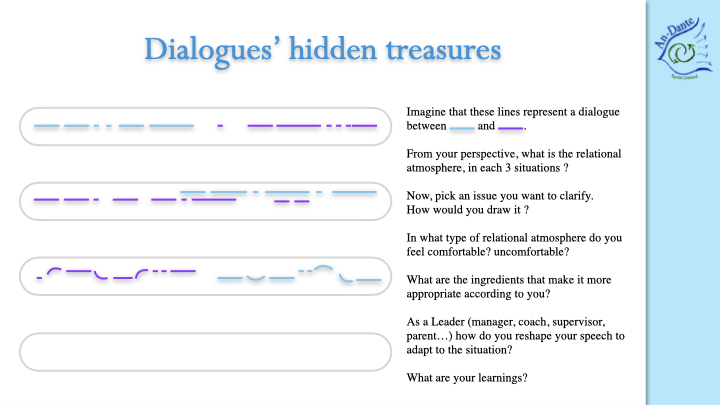
How to get more out of your dialogues, and develop your leadership through your voice, speech pace and words. This self coaching tool is directly drawn from my experience as a choir singer and a relationship systemic coach.
Comment apprendre de vos dialogues, et développer votre leadership, par votre voix, votre prosodie et vos mots. Cet outil d’autocoaching est directement issu de mon expérience de chanteuse en choeur et coach systémique de la relation.
Retour sur une expérience de travail systémique en duo
Quoi ?
L’équipe est en transformation, avec une nouvelle direction, des managers qui évoluent, des responsables d’affaire qui arrivent, et des améliorations souhaitées dans les relations avec les fonctions support. Vient se greffer là dessus le travail avec des personnes à distance, soit pour l’équipe de management opérationnel soit pour des fonctions support.
En bref, les objectifs posés sont :
gagner en efficacité, en conservant la satisfaction client
mieux se comprendre, même à distance
doper la cohésion
Qui ?
La direction de l’équipe
Le Codir
Les managers responsables d’affaires
les principales fonctions support : commerce, ressources humaines, achats, contrôle de gestion
Au total une vingtaine de personnes
Comment ?
L’équipe profite d’un séminaire pour se « mettre au vert » : se poser à distance des préoccupations opérationnelles, et avancer sur ces sujets identifiés.
Le duo des coachs
soutient la direction dans la clarification des objectifs du séminaire
interviewe et questionne l’équipe pour recueillir les attentes et perceptions individuelles
compile les informations recueillies et réalise l’ingénierie du séminaire
anime les séances de coaching
modélise le travail en duo dans :
l’adaptation à la réalité de ce qui est en train de se passer, tout en maintenant le cap permettant d’atteindre les objectifs fixés
le plaisir de travailler ensemble, tout en étant efficaces
soutient l’équipe dans :
ses responsabilités individuelles, selon les différents postes dans l’équipe
ses rôles relationnels pour l’équipe, selon les différentes personnalités
Résultats
Une équipe reboostée et reconnaissante de ce temps de travail différent, prometteur d’améliorations et d’efficacité
Qui a réussi le défi de converger sur une identité partagée et une énergie commune
Des engagements individuels concrets et partagés
Des plans d’action explicites, avec des pilotes et des délais
Paul Caillaud & Agnès Grisard – crédit photo Agnès Grisard
A Look Back on a Systemic Co-Leadership Experience
What?
The team is undergoing transformation: a new leadership team, evolving managers, incoming project leads, and a desire to improve relationships with support functions. On top of this, there’s the challenge of working with remote team members—both within operational management and support functions.
In short, the goals were to:
Increase efficiency while maintaining customer satisfaction
Improve mutual understanding, even at a distance
Boost team cohesion
Who?
The leadership team
The executive committee
Business managers/project leads
Key support functions: sales, HR, procurement, financial control
About 20 people in total
How?
The team took advantage of an offsite seminar to “step back” from day-to-day operational concerns and work on these identified issues.
The coaching duo:
Supported leadership in clarifying the seminar’s objectives
Interviewed and questioned team members to gather individual expectations and perspectives
Compiled this input and designed the seminar program
Facilitated the coaching sessions
Modeled working as a duo by:
Adapting to what was happening in the moment while keeping focus on achieving the set goals
Embodying that working together can be both enjoyable and effective
Supported the team by:
Clarifying individual responsibilities according to their roles
Developing relational roles within the team, based on different personalities
Results
A reinvigorated team, grateful for this different way of working that promises improvements and greater effectiveness
Successful alignment around a shared identity and collective energy
Thanks to a client’s question, here is a process to navigate with a typical toxic relationship situation.
Self Coaching
Once you have read this article, pick one situation where the drama triangle is mostly probable, and unfold what has been going on and how you could improve your own reaction next time.
Remember that to deal with that type of complex relational situation you need to train, fail again, train… and succeed more and more often.
What is this Drama Triangle about ?
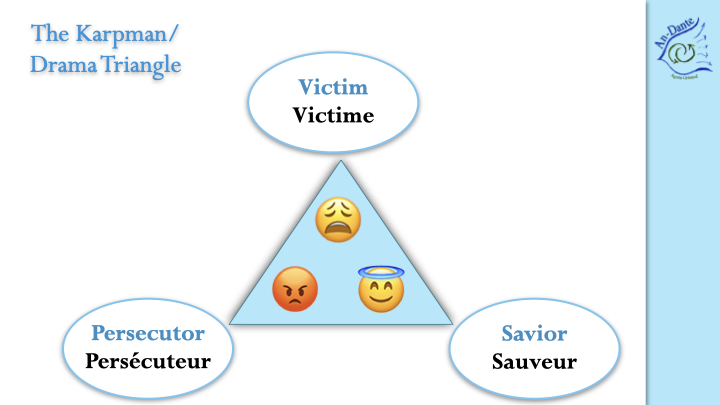
The « Drama Triangle » is a model based on Transactional Analysis and designed by Stephen B. Karpman an American psychiatrist in 1968, unveiling a typical relational scenario with three roles : victim, persecutor and savior.
From a neuroscientific point of view, these three roles are based on automatic modes. And can be analysed as :
the victim being on « flight » or « freeze » mode – either avoidant and frightened, or paralyzed and sad
the persecutor being on « fight » mode – agressive and angry
the savior seeking external acknowledgment of being a good person
Antidotes to the Drama Triangle
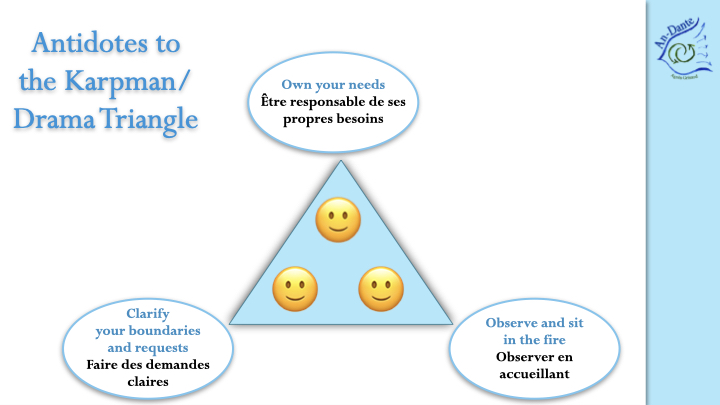
The antidotes to recover freedom out of these automatic modes are :
« Phase 0 » Step back from the game at play :
become conscious that this is a relational game being played, and sort out who is most probably playing what role
in other words : shift your own brain into Adaptive Mode
« Phase 1 » Once you have identified your own role :
antidote for the victim :
recognize their inner feelings, be able to express their needs, take their responsibilities in the situation -vs feeling small or childish, powerless, complaining-
in other words : owning their needs and accepting their own agency on the situation
antidote for the savior :
asking what type of help would be needed, consciously onboarding the risk of not being asked to help -vs helping without having been asked for, and feeling useless-
in other words : sitting in the fire with an observer posture, ready to offer help if asked
antidote for the persecutor :
asking what is needed to solve the problem, in an assertive posture -vs targeting as a victim, controlling, deciding, taking power over-
in other words : setting clear boundaries respectful of other’s boundaries
« Phase 2 » Once you are yourself out of the game you are available to adopt the most appropriate posture toward the two other players :
victim role in flight mode : friendly and openly asking them what they would need to solve the problem, reformulate and help to organize their thoughts
victim role in freeze mode : offering support, recognizing the human skills of the person, and openly asking them what they would need to solve the problem, step by step
savior role : offering the person recognition for them wanting to help, and offering to step back and hold an observer posture, until eventually being asked for help
persecutor role : recognizing the person’s action skills and intelligence, asking them to clarify what action they want to take
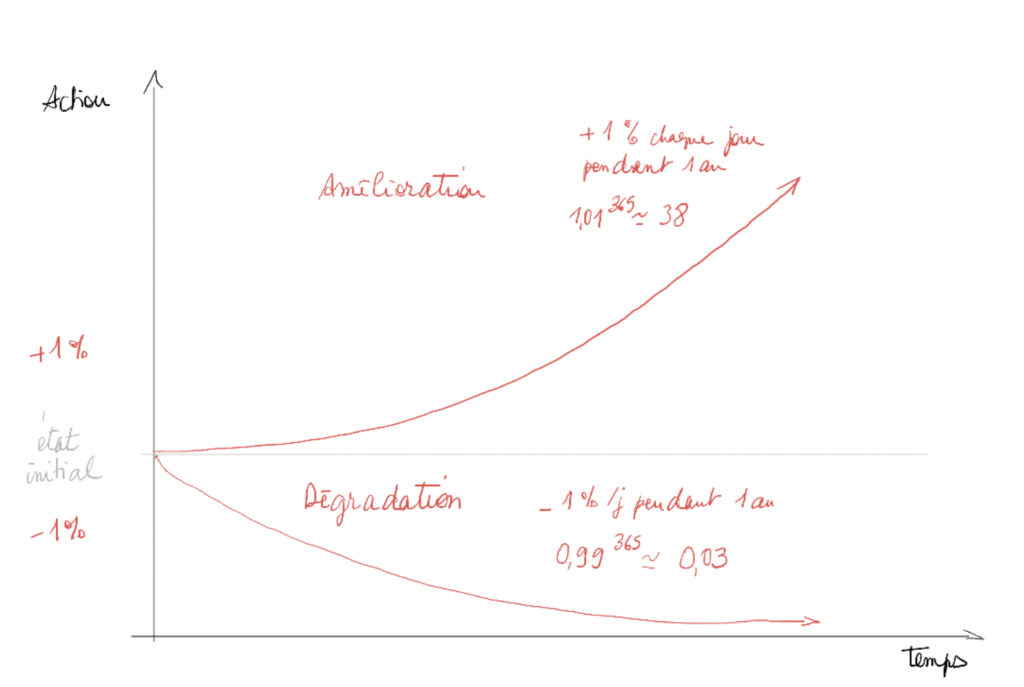
En changeant un petit peu une habitude (+ ou – 1%), quotidiennement, on obtient un résultat très différent dans le temps. C’est la stratégie des petits pas, de l’escalier, de l’éléphant, du sablier… Un grain, une bouchée ou une marche après l’autre !
By slightly changing a habit each day (+ or – 1%), you get a very different result over time. It’s the strategy of small steps—like a staircase, an elephant, an hourglass… One grain, one bite, or one step at a time!
Stair of change – L’escalier du changement – Photo credit A Grisard
Pour comprendre
Changer ses habitudes est un travail de chaque instant.
Si vous changez en améliorant de +1%, alors, vous empruntez la courbe de l’amélioration. Si vous changez en dégradant de -1%, alors vous empruntez la courbe du déclin. Lorsqu’on fait un calcul mathématique, en améliorant de 1% chaque jour pendant une année, on obtient une évolution de 1 à quasiment 38. Pour la dégradation, on passe de 1 à 0,03. Par ce calcul, on observe que le processus d’amélioration amplifie fortement le résultat.
Typiquement, par exemple installer un changement quotidien sur les pensées parasites en passant de « je ne suis pas légitime » à « j’ai les ressources pour » ou encore « ma journée était pourrie » à « voici les 3 pépites de cette journée ». Ou encore « ça me stresse de dire non » à « je peux être curieux de la situation ».
Ou encore changer des comportements non désirés, tels que « je veux limiter ma consommation de café »
L’entrainement des sportifs et des musiciens est d’abord une pratique quotidienne !
Vos connaissances sont une mesure à retardement de vos habitudes d’apprentissage quotidiennes…
Pourquoi ça résiste ?
Paradoxalement, notre esprit résiste, pour différentes raisons.
D’une part, la visibilité de ce changement est ténue, à l’échelle de la journée. Donc pourquoi faire des efforts quand leur effet est quasiment invisible ? Et nous voilà remettre à demain ce changement. D’autre part, notre propension naturelle à limiter les efforts nous fait facilement abandonner nos « bonnes résolutions ». En effet, pour des raisons d’économie, notre cerveau limite ses dépenses d’énergie, aime le mode automatique les habitudes et la routine, c’est le propre de tout système vivant.
Construire votre stratégie
Alors quelles stratégies pour réussir à mettre en œuvre les changements qui vous vous souhaitez ? Pour basculer « du bon côté de la force » ?
D’abord en différenciant ces stratégies selon vos facettes de personnalité. Et en vous branchant sur le plaisir inconditionnel, celui qui fait que vous passez à l’action juste pour le plaisir de faire, sans impression d’effort.
Si vous avez une facette de personnalité qui vous fait aimer organiser, prévoir, anticiper, ou encore comprendre, jouer avec la logique, ou vous fixer des défis à dépasser, alors faire des efforts pour un plaisir différé est plutôt facile. Ces facettes de personnalité zooment et dézooment facilement sur l’échelle de temps pour une vision court terme et long terme.
Si vous avez une facette de personnalité qui se ressource dans l’action immédiate, spontanée, imprévue, via le mouvement, l’échange avec d’autres, l’harmonie relationnelle ou encore la contemplation du moment présent, alors cela peut-être un peu plus compliqué. Vous allez avoir besoin de plus de soutien de l’extérieur. Et être soutenu par vos amis peut être une de vos motivations !
Pour autant, comme nous avons tous plusieurs facettes de personnalité, une stratégie aussi peut être de recruter celle qui va être la plus favorable à ce processus.
Pour passer à l’action, quels sont vos alliés -personnes ou processus- ? Comment allez-vous trouver les ressources internes ou externes pour vous soutenir sur le long terme ?
Ancrer votre stratégie
Notre cerveau est animé par le circuit de la récompense.
C’est d’ailleurs là-dessus que les réseaux sociaux sont basés : scroller donne des « bons points » à notre cerveau. Seulement voilà, cela devient addictif… Et nous y retournons, en dépit de notre raison qui tente de nous empêcher. Même chose pour le grinottage… Ou demander des réponses à Chat GPT. D’autant plus que ces actions ne demandent pas d’effort.
Alors comment utiliser cette connaissance à bon escient ?
Ancrer un changement c’est comme créer un chemin dans la poudreuse toute fraiche : au début, cela demande un effort, et il n’y a que des traces de pas, ensuite une petite voie, enfin un chemin qui devient le chemin favori car facile à emprunter.
Les stratégies pour ancrer le changement sont :
se fixer un objectif clair et mesurable,
matérialiser les évolutions, par une marque sur le calendrier affiché sur le frigo, une bille dans bocal de l’entrée…
et célébrer le changement -se féliciter, partager avec son entourage…-.
Ainsi, votre cerveau voit le changement s’opérer et enregistre l’information vraiment.
To understand
Changing your habits is a constant, ongoing effort.
If you change by improving just 1%, you follow the path of growth. If you change by getting 1% worse, you follow the path of decline.
When you do the math, improving by 1% every day for a year takes you from 1 to nearly 38. On the other hand, declining by 1% each day takes you from 1 down to just 0.03.
This simple calculation shows how the process of improvement greatly amplifies results.
Examples
A typical example of a small daily change could be shifting a negative thought like “I’m not good enough” to “I have the resources I need,” or changing “My day was awful” to “Here are the 3 highlights of my day.” It could be going from “Saying no stresses me out” to “I can be curious about the situation.”
Or maybe you want to change a specific behavior, like cutting back on coffee.
Your current knowledge is a delayed reflection of your daily learning habits.
Athletes and musicians train through daily practice above all!
Why is it so hard to change?
Ironically, our own mind resists change—for a few reasons.
First, the effects of small daily changes are barely visible in the short term. So why make the effort when the results seem almost invisible? That’s when we postpone change until tomorrow.
Second, our brain naturally tries to limit effort. It likes routine, habits, and automatic behaviors—this is true of all living systems. For energy efficiency, it prefers to stay in its comfort zone and maintain the status quo, which makes abandoning resolutions easy.
Build your strategy
So what strategies actually help you follow through with the changes you want? How can you switch over to “the right side of the Force”?
Start by tailoring your strategy to fit your personality traits. And most importantly, connect to intrinsic pleasure—the kind that gets you into action just because you enjoy the activity, without feeling like it’s a chore.
If you have personality traits that enjoy organizing, planning, anticipating, analyzing, or setting goals, then making effort for a future reward might come easily to you. You’re probably good at zooming in and out on timeframes—balancing short-term and long-term thinking.
If your personality thrives more on spontaneity, immediate action, social connection, movement, or being in the moment, it might be a little trickier. You’ll likely need more support from your environment. Encouragement from friends could be one of your biggest motivators!
But since we all have multiple sides to our personality, another effective strategy is to activate the part of yourself best suited for the change you want to make.
To get into action, ask yourself: Who or what are your allies—people or systems—that can support you? How can you access the internal or external resources you’ll need to stay on track long term?
Anchor your strategy
Our brains are wired for reward.
That’s actually how social media works—scrolling gives our brains little “feel-good” hits. But that can quickly become addictive… and we keep going back, even when our rational mind says stop. Same with snacking. Or asking ChatGPT for answers 😉. Especially because those actions don’t require effort.
So how can we use this knowledge in a helpful way?
Anchoring a new habit is like carving a path through fresh snow. At first, it takes real effort—there are just a few footprints. Over time, a small trail forms. Eventually, it becomes the go-to path because it’s now the easiest one to take.
Here are a few ways to anchor change:
Set a clear, measurable goals
Track your progress—like marking a calendar on the fridge or dropping a marble in a jar
Celebrate small wins—give yourself credit, share with others, enjoy the feeling of progress
That way, your brain actually sees the change happening—and really registers it.
Sources
James Clear Atomic Habits – An easy & proven way to build
Approche Neurocognitive et Comportementale – Institut de Médecine Environnementale
Une nouvelle étude de Microsoft met des données sur une réalité : celle d’un environnement professionnel dans lequel notre attention est totalement dispersée.
A new study from Microsoft brings data on a reality : the reality of our professional environment, where our attention is totally scattered.
Un enjeu majeur de notre époque est de préserver des plages dans lesquelles la réflexion peut s’approfondir, sans perturbation externe.
Qu’observez-vous dans votre réalité individuelle ?
Qu’observez-vous chez vos collaborateurs ?
Que mettez-vous en place pour que les cerveaux de votre équipe, aient l’espace et les conditions pour déployer leur puissance et soient préservés du morcellement de l’attention ?
A major challenge of our time is preserving spaces where deep reflection can unfold without external disturbances.
What do you observe in your own individual reality?
What do you observe among your colleagues?
What are your actions to empower your team’s brains and avoid attention scattering?
Les stratégies qui vont favoriser l’attention sont :
pour les stratégies cognitives, l’auto évaluation du niveau d’attention dans l’instant, typiquement sur une échelle de un à 10 quel est mon niveau d’attention ?.
pour les stratégies comportementales, la reconnection à la respiration et au corps, aux sensations, qui vont ralentir la dispersion cognitive et focaliser sur l’instant présent.
les capacités d’attention sont musclées par les techniques de méditation de pleine conscience, Qi Gong, yoga, marche consciente, chant…
The strategies that help enhance attention include:
For cognitive strategies: self-assessment of your current level of attention—typically by asking yourself, “On a scale from 1 to 10, how focused am I right now?”
For behavioral strategies: reconnecting with your breath and body and sensations, which helps slow down mental distraction and refocus on the present moment.
Attention capacity can be strengthened through practices like mindfulness meditation, Qi Gong, yoga, mindful walking, singing, and more.
Le défi de l’attention est « seulement » de pratiquer quotidiennement !
The challenge for attention is « only » daily pratice !
From the Perspective of a Coach Supervisor and a curious mind in this earth.
As artificial intelligence becomes increasingly present and conscious in our lives, its integration into coaching raises important questions for coaches and their clients.
These reflections aim to support deeper thinking and intentional practice in the evolving coaching landscape:
How can coaches develop as skilful relationship to uncertainty, and the natural aversion to risk?
How can coaches hold a space that honors the coachee’s ownership of their goals, supporting them in clarifying what they need to achieve those goals, from their unique perspective, including cultural context and lived experience?
How can coaches cultivate self-awareness around their own instinctive and emotional brain governances—those unconscious processes that shape their thoughts, feelings, and behavior—so they can remain fully present and generative for their clients in the moment?
How can coaches expand their use of AI, to help their clients use it effectively as a training tool, or a copywriting support, or anything else they want to achieve?
How can coaches support their clients to discern between AI-generated responses and human insightful and creative responses, and support them to go over the trap of mistaking illusion for truth (or, as the French saying goes, “prendre des vessies pour des lanternes”)?
Photo credit A Grisard
Finally, what would this mischievous young boy think about it all, and the guys in the background ?
Une réflexion sur l’intelligence artificielle & coaching professionnel
Provenant de la perspective d’une superviseure de Coach et d’un esprit curieux sur cette terre.
Alors que l’intelligence artificielle est de plus en plus présente et consciente dans nos vies, son intégration dans le coaching, soulève des questions importantes pour les coachs et leurs clients.
Comment les Coachs peuvent-ils travailler leur relation avec l’incertitude et l’aversion naturelle au risque ?
Comment les Coachs peuvent créer un espace qui soutient la responsabilité du Coaché face à ses objectifs, en l’aidant à clarifier ce dont il a besoin pour les atteindre, en s’appuyant sur son unicité, avec sa culture et ses expériences vécues.
Comment les Coachs peuvent-ils cultiver leur conscience de leurs propres gouvernances émotionnelle et instinctive, ces processus inconscients qui sous-tendent leurs pensées, émotions et comportements, afin de rester complètement présents et créatifs pour leur client, dans l’instant.
Comment les Coachs peuvent-ils développer leurs propres compétences d’utilisateurs d’intelligence artificielle, pour aider leurs clients à l’utiliser de façon efficace, comme un outil d’entraînement, un outil d’écriture, ou quoi que ce soit qui les aide ou quoi que ce soit qu’ils souhaitent accomplir.
Comment les Coachs peuvent-ils soutenir leurs clients dans le discernement entre des réponses générées par de l’intelligence artificielle et des réponses humaines empreintes de créativité, et les soutenir pour dépasser l’écueil de « prendre des vessies pour des lanternes »
Enfin, qu’est ce que ce jeune homme facétieux penserait de tout cela, et les gens de l’arrière plan ?
The aim of professional coaching is to create a reflective space where the Coachee can be supported by the Coach, to define their objective, and journey to reach them, through consistent action.
Being a Coach requires a complex set of skills. And is a lifelong professional journey !
So, from the Coachee’s perspective, how to choose a coach ?
As a metaphor, when you are buying a jacket, you know it will suit you because you know your usual size and sizes are normalised and assessed worldwide. So you have a frame of reference to lean on.
The professional coaching associations have designed competency models to assess Coach’s competencies.
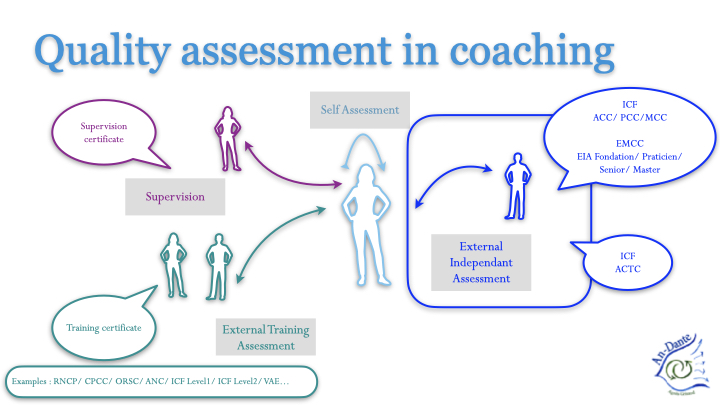
Here is a graph to clarify the different kinds of assessment, and find your way through the many different acronyms !
In the center stands the Coach. One professional skill is Self Assessment. During the coaching session, the coach is observing themselves and making choices to work with their client.
The standards for these skills are the Coaches Competency Models. ICF and EMMC have build their Skill Requirements. Those two documents are quite alike.
However, as one of my clients in Supervision stated it lately, knowing the path is different from walking the path !
So to thrive from knowing to walking the path, a coach needs to : 1) train, learn tools, postures, psychology fundamentals… 2) have a Supervision space, to explore their « walking the path » with a neutral professional, and learn from it, and grow their capacity for self assessment in the moment
To give proofs of their real capacities with coachees, a coach’s work is assessed by an independant assessment process. In this kind of assessment, the coach brings proofs of their trainings, coaching hours, number of clients, supervision hours, and recordings with real clients. And the certificate has a validity period. The assessors and the coach are totally independant : they don’t know each other. This to secure a neutral assessment, based on Skill Requirements.
So now that you have read this article, you should have a clearer idea of what’s behind, when you are reading a Coach’s profile. If not, ask about Supervision Certificate, and external certificates -ICF or EMCC- !
How interesting to read so many papers and posts about « How to become a better coach with AI »…
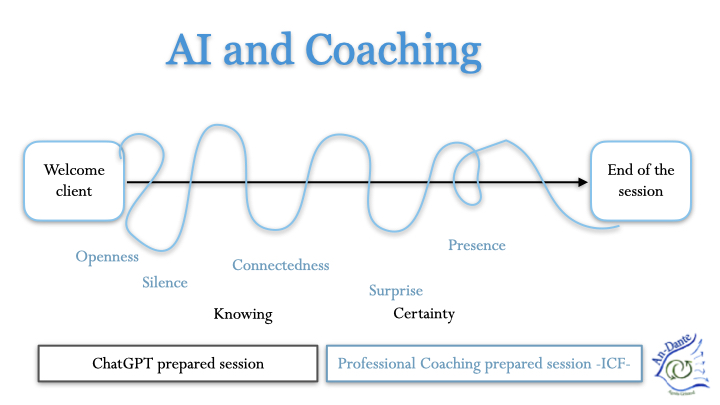
These coach counsellors offer many advices, techniques and services. They know how to become a better coach. They know what the client needs before the session. They analyse with Chat GPT what has been going on in the former session and design the next session.
This is highly interesting, since it offers a clear example of what is understood as « coaching » in many minds. ie. giving advices, directing client, knowing or making assumptions on what they think, believe… and guiding them out of these wrong or ineffective paths, because they know -since chat GPT has told them- what is good and what is bad for their client.
Would you say those two postures and offers are the same ?
If not, how would you name them to discern and understand fully what is inside their value proposition ?
However Chat Gpt can be a tremendous assistant in business for professional coaches, with marketing, scheduling, invoicing, keep an eye on trends…
From the ICF professional coaching Core Competency Model, a coach :
demonstrates ethical practice
among them : maintains the distinctions between coaching, consulting, psychotherapy and other support professions
Abides by the ICF Code of Ethics and upholds the Core Values
embodies a coaching mindset
Acknowledges that clients are responsible for their own choices
Remains aware of and open to the influence of context and culture on self and others
Uses awareness of self and one’s intuition to benefit clients
Develops and maintains the ability to regulate one’s emotions
Mentally and emotionally prepares for sessions
establishes and maintains agreements
Explains what coaching is and is not and describes the process to the client and relevant stakeholders
Reaches agreement about what is and is not appropriate in the relationship, what is and is not being offered, and the responsibilities of the client and relevant stakeholders
Partners with the client and relevant stakeholders to establish an overall coaching plan and goals
Partners with the client to identify or reconfirm what they want to accomplish in the session
Partners with the client to define what the client believes they need to address or resolve to achieve what they want to accomplish in the session
Continues coaching in the direction of the client’s desired outcome unless the client indicates otherwise
cultivates trust and safety
Seeks to understand the client within their context which may include their identity, environment, experiences, values and beliefs
Demonstrates respect for the client’s identity, perceptions, style and language and adapts one’s coaching to the client
Acknowledges and respects the client’s unique talents, insights and work in the coaching process
Acknowledges and supports the client’s expression of feelings, perceptions, concerns, beliefs and suggestions
maintains presence
Remains focused, observant, empathetic and responsive to the client
Demonstrates curiosity during the coaching process
Manages one’s emotions to stay present with the client
Demonstrates confidence in working with strong client emotions during the coaching process
Is comfortable working in a space of not knowing
Creates or allows space for silence, pause or reflection
What happens when you meditate? You’re working out your « attention muscles ». Just like when you’re playing the piano.
Credits : A Grisard
While practicing, you are upgrading your piano player skills. And if you stop working out your capacity decreases. That’s a hard reality that made me stop learning the piano decades ago, but I kept singing because I had a better effort-pleasure balance.
When you meditate you upgrade your attentional skills to be present in the moment and to be conscious of what draws your attention somewhere else like sounds, sensations, thoughts.
But what are the benefits in meditating daily?
Neuroscientists have clarified that you can only act on the present moment : you cannot change the past, you can dream the future, but not really act on it.
Being present in the moment brings also presence to what’s here for you. What’s important, what is salient in all the things that you have in mind, among the multitude of signals either thoughts, sensations, odors, sounds etc.
Inside this whole music, what are the particular sounds you need to pay attention to?
Cultivating your attention brings insights and drives you to the most important signals, to you, in the moment, and thus enhances your decision-making and prioritization. This might also be called performance 🙂
So to land this piece of reflexion :
to benefit meditation effects, you need to practice… daily
each session won’t bring the « wahoo effect », though some might
in the middle term, you will notice changes in your awareness capacity, thus enhancing of your decision making, attention, insight, lower stress level…
If we are working together, in coaching or supervision sessions, you’ll discover a variety of meditation practices, and surely find what’s convenient for you ! To practice daily, you can choose Apps on your phone, many are really helpful -I use Insight Timer-, you can also start with a mindfulness session, with an instructor -I’ll be happy to share names with you-.
Que se passe-t-il lorsque vous méditez ? Vous exercez les muscles de votre attention. Tout comme lorsque vous jouez du piano.
Lorsque vous vous exercez vous améliorez vos compétences au piano. Et si vous arrêtez de vous exercer vos compétences diminuent. C’est cette dure réalité qui m’a fait arrêter d’apprendre le piano, il y a quelques dizaines d’années mais continuer de chanter parce que j’avais un meilleur équilibre effort-plaisir.
Lorsque vous méditez vous augmentez vos capacités attentionnelles à être présent dans l’instant, et à être conscient de ce qui capte votre attention, tel que des sons, des sensations, des pensées.
Mais quelles sont les bénéfices de méditer au quotidien ?
Les neuro scientifiques ont clarifié le fait qu’on ne peut agir que dans le moment présent : on ne peut pas changer le passé, on peut rêver le futur sans vraiment avoir une action dessus.
Être présent dans le moment ramène aussi à la présence de ce qui est là pour soi. Ce qui est important, ce qui est saillant parmi tout ce qu’on a en tête, dans la multitude des signaux que ce soient des pensées, des sensations, des odeurs, des sons, etc.
Au milieu de cette musique d’ensemble, quels sont les sons particuliers auxquels vous devez prêter attention ?
Cultiver son attention amène des insights -c’est à dire des flash de créativité, ou d’évidences, de fulgurance- et clarifie les signaux les plus importants pour soi dans l’instant et ainsi améliore notre capacité de prendre des décisions et de prioriser. Cela pourrait bien aussi s’appeler de la performance😉
Alors pour atterrir dans cette réflexion :
Pour bénéficier des effets de la méditation, il faut pratiquer tous les jours
Chaque moment ne va pas forcément être générateur du « waouh effect » même si parfois ça arrive
À moyen terme, vous allez prendre conscience de changements dans votre capacité de conscience attentionnelle, et ainsi augmenter vos capacités de prendre des décisions d’être attentifs, d’avoir des insights et baisser le niveau de stress
Si nous travaillons ensemble en coaching ou en supervision, vous aurez accès à une variété de pratiques et saurez trouver ce qui vous convient ! Pour pratiquer au quotidien, vous pouvez choisir des applications sur votre téléphone, il en existe de nombreuses vraiment utiles –j’utilise Insight Timer– Vous pouvez aussi commencer par des séances avec un instructeur, et je serai ravie de partager des noms avec vous, en privé.
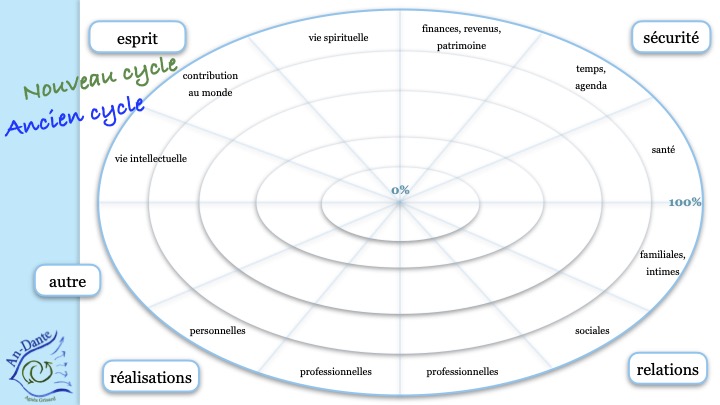
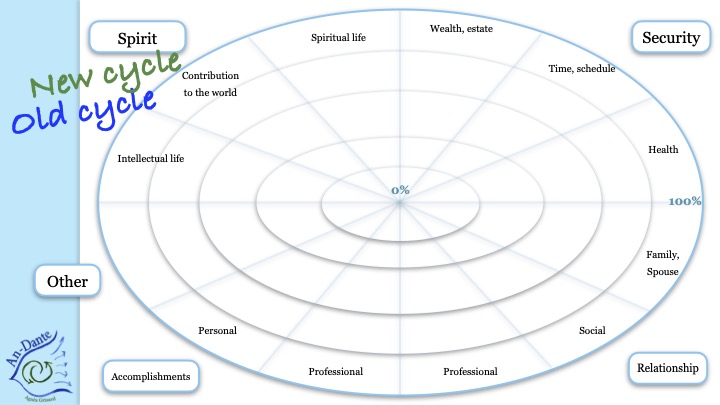
Au démarrage d’un nouveau cycle, je vous propose un exercice d’auto-coaching pour faire le bilan du cycle qui s’achève et vous projeter dans votre prochain voyage.
Ce cycle peut-être celui de l’année, de la saison, du trimestre… A vous de choisir votre tempo !
imprimez ou reproduisez ce graphique
dans une couleur, indiquez le pourcentage de chaque quartier, de 0 à 100%, dans l’état actuel de votre vie
qu’est-ce qui émerge ?
dans une autre couleur, indiquez à quoi vous aspirez
qu’est ce qui émerge ?
de quoi avez-vous besoin pour aller de l’état actuel à l’état désiré ?