L’assertivité, vous en avez probablement entendu parler. Mais que recouvre ce terme, et surtout en quoi est-ce que l’assertivité peut vous aider au quotidien ?

Team & Leader Performance via Harmonized Relationship
Article in English below
Dans ce article, nous vous proposons une plongée dans le monde des émotions, pour mieux les comprendre, et mieux les apprivoiser !
In this article, we invite you to dive into the world of emotions to better understand and embrace them!

« Le stress n’est pas une émotion mais bien l’effet d’une compression que les exigences extérieures imposent à nos émotions. Ce qu’il faut ce n’est donc pas éliminer le stress : c’est être en contact avec nos émotions et nous servir de l’information qu’elles contiennent pour agir sur le stress en tenant compte de nos besoins. » Michèle Larivey.
“Stress is not an emotion but rather the effect of pressure that external demands impose on our emotions. The goal is not to eliminate stress but to stay in touch with our emotions and use the information they provide to address stress while considering our needs.” — Michèle Larivey.
En d’autres mots, le stress nous donne une information que quelque chose « bug » dans notre cerveau ! Ou du moins dans notre façon de percevoir la situation. Cette information est constituée notamment de nos ressentis et émotions. A nous d’en faire quelque chose pour changer la situation et nous transformer. Dans l’instant. Et c’est aussi un travail qui porte sur le long terme.
En voici des clefs concrètes.
Nos apprentissages sur la vie émotionnelle, nous viennent de notre famille et notre culture. Ca, c’est fait !
Cela dit, bonne nouvelle : nous pouvons poursuivre nos apprentissages toute notre vie !
Sentiment : sans sensation corporelle forte, durable, délicat et subtile
Émotion : avec sensation corporelle plus ou moins intense, non durable, envahissante, réaction intérieure vive avec une intensité
Expérience émotive : résultat du processus d’experiencing, faite d’émotions, des sensations qui en découlent, des pensées. Se centrer, c’est porter son attention sur l’expérience immédiate pour l’accueillir et y accéder.
Les émotions ou les sensations sont un signal de ce que nous vivons. En qualité et en intensité. Ce signal a une signification subjective, lié à notre système de pensée individuel, et elle renvoie à un besoin, dans l’instant présent.
Les sensations nous parviennent par nos cinq sens vue, ouïe, toucher, odorat, goût, et le mouvement.
Les émotions sont au cœur de notre système de communication. Les émotions sont décrites par les mots que nous leur affectons et les sensations qui leur sont liées. Par exemple, si j’ai peur, je relie ce mot à la sensation d’avoir le coeur qui accélère, le souffle court, la voix chevrotante et peut-être aussi une salivation différente (en plus ou en moins)
Plus nous sommes capables d’exprimer et d’extérioriser nos émotions, plus le contact avec nous est enrichissant pour ceux qui nous côtoient. Nous leur donnons ainsi accès à notre vie intérieure. Et ce que nous vivons les concerne souvent.
Michèle Larivey scinde les émotions en 4 catégories (que l’on retrouve également peu ou prou chez d’autres auteurs) :
Chacune des émotions simples rend compte d’un besoin. Elle est donc la clef d’accès au besoin et la satisfaction de celui-ci éteint l’émotion qui n’a alors plus besoin de se manifester puisque le besoin est comblé.
Certaines émotions se manifestent par rapport au responsable ou à l’obstacle, telles que l’amour, l’affection, la fierté. Le besoin peut alors être plus enfoui.
Les émotions d’anticipation concernent ce qui pourrait survenir. Elle sont le fruit de notre imagination, telles que l’excitation, l’appétit, l’inquiétude, la peur, le trac. Elles sont aussi des indicateurs de nos besoins sous-jacents.
Quand un besoin est satisfait, le système est à l’équilibre. Quand il n’est pas satisfait ou qu’un nouveau besoin apparaît, le système est en déséquilibre. Chez l’humain, le besoin est physique -exemple la soif : besoin d’eau- et psychologique -et peur : besoin de protection-.
L’émotion nous signale donc à quel point nos besoins sont satisfaits ou non.
Et chacun.e est responsable de la satisfaction de ses propres besoins.
Le travail sur les émotions consiste à faire des allers-retours entre le ressenti d’une sensation corporelle, et des mots précis pour nommer l’émotion. Cela nous permet d’accéder à la compréhension de ce que nous vivons.
Cette expérience de boucle du processus émotionnel s’enrichit au fur et à mesure de la pratique. Et cet entrainement augmente notre intelligence émotionnelle.
Le processus naturel de croissance, ou processus vital d’adaptation, se déroule en 5 phases :
Ci-après, vous trouverez, par émotion, les caractéristiques de l’émotion, du sentiment ou d’un autre signal, et l’intérêt de ce signal. Ce sont des pistes pour clarifier ce que vous pourriez faire de ces signaux.
Nos émotions sont des signaux de notre intelligence et des manifestations que nous sommes vivants et en mouvement.
Alors et si nous apprenions à les entendre et à nous servir d’elles comme levier de développement dans la relation à nous-même et aux autres ?
In other words, stress gives us information that something is “glitching” in our brain—or at least in how we perceive a situation. This information consists of our feelings and emotions. It’s up to us to do something with it—to change the situation and transform ourselves, both in the moment and in the long term.
Here are some practical keys to understanding and managing stress.
Our emotional learning comes from our family and culture. That part is already set. But the good news is that we can continue learning throughout our entire lives!
Feeling : does not involve strong bodily sensations, subtle, delicate, and long-lasting.
Emotion : involves bodily sensations of varying intensity, temporary, can be overwhelming, intense inner reaction.
Emotional Experience
It is the result of an internal process that includes emotions, the sensations they produce, and our thoughts. Focusing on emotions means paying attention to the immediate experience, accepting it, and accessing its deeper meaning.
Emotions and sensations signal what we are experiencing—both in quality and intensity. These signals are subjective and tied to our personal thought systems. They point to an unmet need in the present moment. Our sensations come through our five senses (sight, hearing, touch, smell, taste) and movement. Emotions are at the core of human communication. They are expressed through both words and the physical sensations they trigger.
For example, if I feel afraid, I might notice my heart racing, shortness of breath, a shaky voice, changes in saliva production.
The more we can express and externalize our emotions, the more meaningful our interactions become. Sharing our inner world allows others to understand us—and often, what we feel affects them too.
Psychologist Michèle Larivey classifies emotions into four categories (a system echoed by other experts as well):
Positive simple emotions indicate satisfaction and are linked to the instinctive calm response described in neuroscience.
• Pleasure
• Joy
• Delight
• Affection
• Pride
• Love
Negative simple emotions indicate dissatisfaction and are linked to the neurosciences instinctive governance fight-or-freeze.
• Boredom
• Sadness
• Disappointment
• Melancholy
• Disgust
• Pain
• Anger
• Rage
• Impatience
• Frustration
Each simple emotion is connected to a need. Once the need is met, the emotion naturally fades. Some emotions relate specifically to a person or obstacle, such as love, affection, or pride. These emotions may point to deeper, hidden needs.
These are emotions about what might happen. They come from our imagination and help reveal underlying needs, like excitement, appetite, anxiety, fear, stage fright. They are also signs of unsatisfied needs.
Mixed emotions mask deeper issues and require careful analysis.
• Guilt
• Jealousy
• Contempt
• Pity
• Disgust
• Shame
Counter-Emotions
These are physically intense emotions that reveal what we suppress or try to avoid. They are linked to the flight instinctive governance.
• Anxiety
• Panic
• Nervousness
Pseudo-Emotions
• Feeling rejected
• Being conflicted about someone you love, feeling trapped, insignificant, or amazing
• Feeling confused, depressed, or emotionally drained
• Behaviors : openness, curiosity, warmness, hostile, judgments (which are not feelt) like stupid, ridiculous, pathetic
When a need is met, we feel balanced. When it isn’t met, or when a new need arises, we feel off balance. Human needs are both physical (e.g., thirst → need for water), psychological (e.g., fear → need for protection)
Our emotions tell us how well our needs are being met.
And importantly: each person is responsible for meeting their own needs.
The key to managing emotions is going back and forth between bodily sensations and specific words to name the emotion.
This process helps us understand what we’re experiencing and improves with practice—strengthening emotional intelligence over time.
1. Emergence – The emotion appears. At first vague, it becomes clearer when we stay present with it. Naming the emotion completes this phase.
2. Immersion – Fully experiencing the emotion without resistance. Many people struggle here, but accepting an emotion as it is allows progress.
3. Development – Understanding its nuances and complexities.
4. Insight – Gaining clarity about why the emotion is there. True insight is a sudden realization, unlike premature explanations that may arise earlier.
5. Unifying Action – Expressing or acting on the insight in a way that aligns with your values. This resolves the emotional cycle and makes space for new experiences.
Each emotion carries valuable information:
Tenderness & Tears
Fulfills an emotional need.
Anger
A sign of imbalance.
Manifests dissatisfaction, a lack, or an unmet need.
Contentment
Satisfaction.
Feel it, surrender to the emotion, and nourish yourself with it.
Desire
An emotion of anticipation, fantasy.
Provides information about a need, an aspiration, a search for balance and satisfaction; a sign of vitality.
Boredom
Lack of meaning.
An unmet need, frustration, passivity; helps identify what truly matters, break free from “shoulds,” reconnect with oneself, and take ownership of one’s choices.
Impatience
Doing something insignificant while neglecting what truly matters.
Indicates that we are wasting time and invites us to invest it in something more meaningful.
Fear
A subjective anticipation of danger.
Encourages us to assess the reality of the danger and take measures to protect ourselves.
Pleasure
Satisfaction of a need, the harmonious fulfillment of a vital requirement.
Indicates that a need has been met.
Sadness
Signals an emotional loss.
Invites us to identify and address this lack, restoring our psychological energy.
Love
A spontaneous emotional movement toward someone who brings us satisfaction and inspires us to surpass ourselves.
Reveals the presence of crucial needs or aspirations, the desire to be recognized for our capacity to attract, and the need for essential validation from the other person.
Healthy Guilt
A deliberate action against my values.
Highlights an internal imbalance or self-disagreement; once clarified, it allows us to take responsibility and make amends.
Guilt of Concealment
Making one’s actions seem more acceptable to oneself and others.
Encourages us to take responsibility for our actions.
Disgust
Weariness, aversion, and disapproval.
Indicates an overload, that we have gone too far.
Pride
A form of self-satisfaction infused with self-esteem.
Indicates that we have taken action up to our standards and invested ourselves in it; may be perceived by others as arrogance or boasting, which invites us to own our achievements and express this emotion openly.
Shame
Social guilt triggered by others’ judgment.
Encourages us to recognize what we struggle to accept about ourselves, clarifies how we judge ourselves, and highlights the importance we place on others’ opinions. Offers an opportunity for personal growth and behavioral freedom.
Jealousy
Anger toward someone who has something I desire.
Through the envy it carries, invites us to identify our own needs and acknowledge our resistance to fulfilling them.
Romantic Jealousy
A mix of fear and anger triggered by insecurity.
Reflects the fear of losing an important benefit from the relationship and insecurity about our attractiveness. Encourages self-confidence development and relationship clarity.
Contempt
• Concealed Contempt: Anger and fear, possibly jealousy, dissatisfaction, a defense against hurt, rejection of the relationship.
• Reactive Contempt: Anger, an admission of disagreement with someone who does not meet our moral expectations, a desire for connection.
Encourages self-exploration to uncover the true cause behind our contempt, leading to acceptance of our vulnerability and honest emotional expression.
Pity
Underlying contempt.
Masks an emotion under socially acceptable appearances, requiring deeper identification.
Fatigue
Excessive emotional expenditure.
A large investment of psychic energy to suppress emotions or fatigue following an intense emotional experience. Signals a need for emotional and physical rest. Encourages opening up to the underlying emotion by breathing and embracing it.
Embarrassment
Occurs when we deny ourselves pleasure or contentment and attempt to replace it with indifference.
Indicates inner conflict between pleasure and its repression due to an inability to fully embrace it or the vulnerability it exposes. Disappears when we accept and openly experience pleasure.
Blushing, Memory Loss, Loss of Focus, Stuttering
An internal struggle between an emerging emotion and the desire to hide it.
Encourages us to accept both the emotion and its expression, embracing ourselves as we are by identifying the emotion seeking to surface and its triggers.
Disappointment
Indicates that an expectation was not met.
Encourages us to clarify our initial expectations and desires, then examine our role and others’ roles in fulfilling them.
Distancing, Withdrawal
Reflects dissatisfaction, frustration, or even anger that remains unexpressed.
Encourages us to express what we feel and embrace the liveliness of the relationship.
Frustration
A state of dissatisfaction, coupled with a sense of injustice, generating anger, jealousy, or sadness.
Encourages us to take an active role in relationships, take charge of our lives, and ensure our needs are met.
Helplessness
Inability or impossibility to take action or achieve goals.
Highlights obstacles preventing satisfaction, urging us to distinguish between what is within our control and what is not. This clarification helps break free from paralysis.
Manipulation
An action imposed on us, pushing us to do things we do not want to do, triggering emotions we resist, making us vulnerable to control.
Encourages awareness of the emotion at play and resistance to manipulation.
Gratitude
A sense of indebtedness to someone who has done us a favor.
Indicates that we have received something valuable, perceived as a privilege. To fully embrace the experience, we must express our gratitude, which fosters a sense of fulfillment and strengthens the relationship.
Our emotions are not obstacles—they are signals. They guide us toward self-awareness and growth.
So, what if we learned to listen to them and use them as tools for personal development and deeper connections?
Nous prenons plusieurs milliers de décisions par jour, un grand nombre d’entre elles de manière automatique et inconsciente ou peu consciente. Comme mettre des lunettes, marcher, respirer…
Que se passe-t-il dans notre cerveau dans le processus de prise de décision ?
Comment se passent nos prises de décision ?
Qu’est-ce qui fait que nos émotions influent sur nos décisions ?
Comment notre capacité de réflexion influe-t-elle ?
Parfois, nous sommes « déclenchés » par des situations. Ce qui entraine une réactivité émotionnelle instantanée, dont l’intensité peut nous paraitre étonnante ou inappropriée, avec du recul.
Que se passe-t-il dans ces situations d’hyper-réactivité émotionnelle ?
Sometimes we are « triggered » by situations. This leads to an instant emotional reactivity, the intensity of which may seem surprising or inappropriate, with hindsight.
What happens in these situations of emotional hyper-reactivity?

Quelque chose nous « déclenche », mettant immédiatement en route notre gouvernance instinctive, celle qui est chargée de notre survie. Autant dire que la réponse ne traine pas !
Ensuite, les choses se déroulent, selon 3 types de scénarios illustrés ci-dessus :
Scénario 1 : nous ne faisons rien de particulier, et les choses évoluent dans le temps.
Scénario 2 : nous activons une bascule mentale, et le signal de stress diminue progressivement
Scénario 3 : nous nous rendons compte qu’il se passe quelque chose, avant d’arriver tout en haut de l’échelle du stress et nous activons une bascule mentale.
L’impact du stress, notamment en terme de consommation d’énergie est proportionnel à la surface sous la courbe de chaque scénario. Il est donc plus écologique pour nous d’être dans le scénario 3 !
Bonne nouvelle, basculer mentalement s’apprend et se travaille par de l’entrainement quotidien.
Etape 1 : se rendre compte que nous avons commencé l’ascension de l’échelle, que nous avons quitté notre état de calme
Etape 2 : identifier ce qui nous déclenche, en nous interrogeant : quelle valeur est touchée ?, sur quel « bouton rouge » a-t-on appuyé ?, quel besoin n’est pas satisfait ?
Etape 3 : déclencher un exercice de bascule mentale pour revenir à notre calme, prendre de la hauteur
Etape 4 : apprendre de la situation, et s’entrainer, pour être de plus en plus capable de passer du scénario 1, au scénario 2, puis au scénario 3.
Pour aller plus loin : Echelle d’inférence
Something « triggers » us, immediately setting in motion our instinctive governance, the one that is responsible for our survival. In other words, the answer does not drag!
Then, things unfold, according to 3 types of scenarios illustrated above:
Scenario 1 : we do not do anything in particular, and things evolve over time.
Scenario 2: we activate a mental switch, and the stress signal gradually decreases
Scenario 3: we realize that something is happening, before we arrive at the very top of the stress ladder and we activate a mental switch.
The impact of stress, particularly in terms of energy consumption, is proportional to the area under the curve of each scenario. It is therefore more ecological for us to be in scenario 3!
Good news, switching mentally is learned and worked on through daily training.
Step 1 : realize that we have started the climb of the ladder, that we have left our state of calm
Step 2 : identify what triggers us, asking ourselves: what value is affected?, on which « red button » was pressed?, what need is not satisfied?
Step 3: trigger a mental rocking exercise to return to our calm, gain height
Step 4 : learn from the situation, and train, to be more and more able to move from scenario 1, to scenario 2, then to scenario 3.
To go further: Inference scale
in English below
Il reste une part de votre gâteau préféré au milieu de la table. Le hic, c’est que chacun des gourmands autour de la table voudrait bien s’en délecter…
Comment réagissez-vous ?
L’assertivité peut vous aider à vivre au mieux ce type de situation 😉 et bien d’autres !
There’s one slice of your favorite cake left in the middle of the table. The catch? Everyone at the table has their eye on it…
How do you react?Assertiveness can help you navigate this kind of situation—and many others—smoothly!
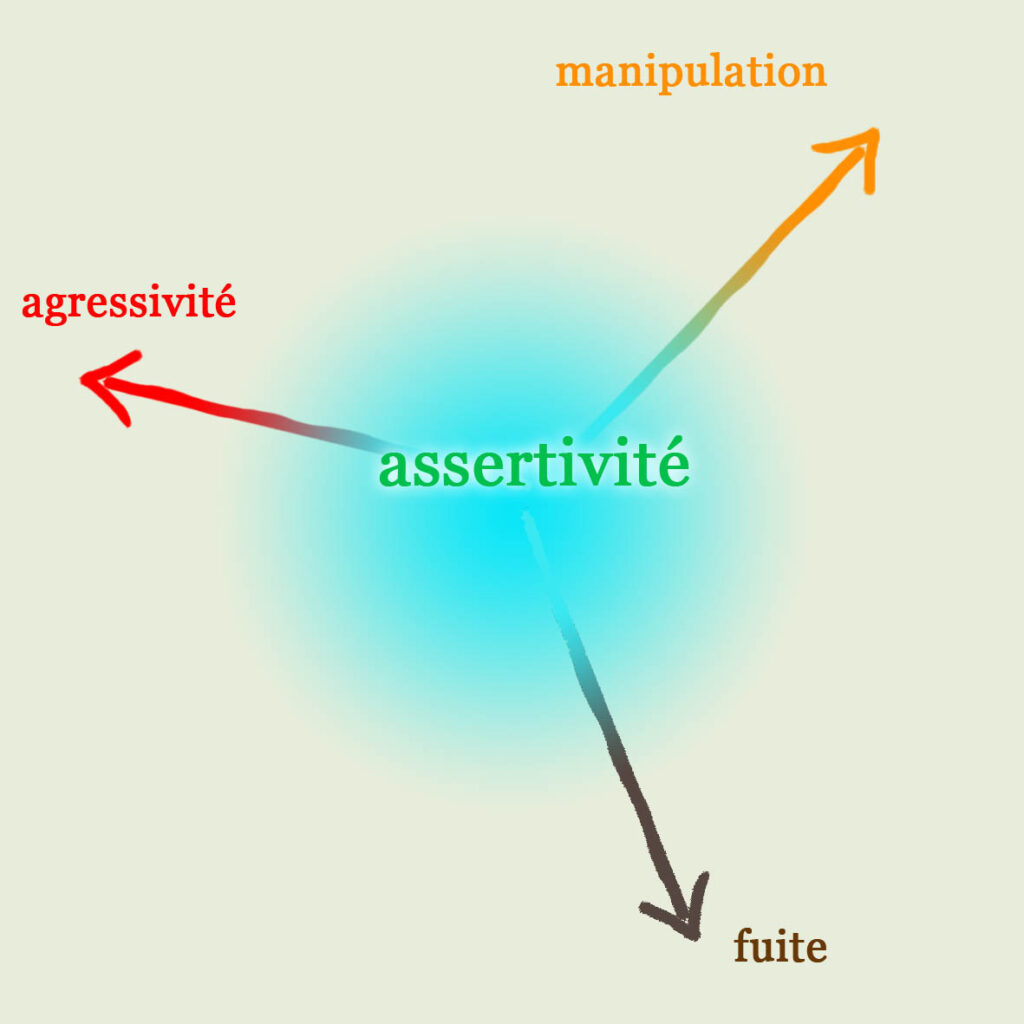
L’assertivité c’est la posture dans laquelle vous n’êtes :
Vous êtes donc au centre du schéma.
Dans l’exemple :
Dans toutes les relations humaines, les échanges sont liés à la posture de la personne. Celle-ci est très liée à l’éducation et au mode de fonctionnement familial. Et bien sûr à la situation et aux interlocuteurs en présence ! Enfin, votre niveau de stressabilité rentre aussi en ligne de compte, c’est à dire la position du curseur sur une échelle stressé-calme.
En prendre conscience vous permet de faire évoluer votre posture, petit à petit, sur des sujets peu importants au départ, puis sur des sujets plus cruciaux pour vous !
Pour être assertive-assertif, il faut que vous soyez connecté/e à vos besoins. Pour cela, je vous invite à lire l’article Comment utiliser la pyramide de Maslow, pour soi et son équipe ? Et si vous faisiez un tour du côté de vos besoins, pour mieux communiquer ?
Enfin, culturellement, les femmes sont le plus souvent incitées à prendre soin des autres, donc à faire passer leurs besoins après ceux de leur entourage ! Je fais allusion au mythe de l’épouse modèle et de la mère nourricière ou mère parfaite, qui se traduit en entreprise par celui de l’employée modèle et fidèle…
Lorsque vous exprimez votre posture de façon assertive, utilisez des tournures de phrases comme :
Et vous, quels début de phrases utilisez-vous pour être assertive/assertif ?
Assertiveness is the stance in which you are:
1. Neither aggressive,
2. Nor avoidant,
3. Nor manipulative.
You are therefore at the center of the spectrum.
In the example:
• An avoidant reaction would be to say nothing and let others share the last piece of cake.
• An aggressive reaction would be to devour it before anyone else has a chance to react.
• A manipulative reaction would be to tell the others that they already had a bigger piece than you and that it really wouldn’t be fair if they took more, or to guilt-trip them about their figure…
• An assertive reaction would be to simply say that you really want that piece.
In all human interactions, communication is influenced by a person’s stance. This is closely linked to upbringing and family dynamics, as well as the specific situation and the people involved. Additionally, your stress tolerance plays a role—meaning where you fall on the stressed-to-calm spectrum.
Becoming aware of this allows you to gradually adjust your stance—first in less significant situations, then in those that matter more to you.
To be assertive, you need to be connected to your own needs. To explore this further, I invite you to read the article How to Use Maslow’s Pyramid for yourself or your team. Maybe It’s Time to Check In on Your Needs for Compassionate communication.
Culturally, women are often encouraged to prioritize others’ needs over their own. This ties into the myth of the “perfect wife” and the “nurturing mother,” which extends into the workplace as the expectation of the “loyal, model employee.”
When expressing yourself assertively, use phrases like:
• It’s important to me to…
• I need to…
• I would like to…
• I wish to…
What about you ? What sentence starters do you use to express yourself assertively?
Article en français ci-dessous
How does our brain work? Are there specific operating modes that characterize our behaviors, what we feel, and what we think?
Between two people who are laughing, are there similarities in how their brains function?
Comment fonctionne notre cerveau ? Y a-t-il des modes de fonctionnements particuliers qui caractérisent nos comportements, ce que nous ressentons et ce que nous pensons ?
Entre deux personnes en train de rire, y a-t-il des similitudes de fonctionnement cérébral ?

Our brain works by activating connections between neurons, which transmit information through this incredibly dense and complex network. In practical terms, a lot of information is sent to different parts of our brain.
Today, we know that certain areas are specialized for specific functions, such as speaking, feeling fear, memorizing, playing the violin, singing, and so on.
We also know that the brain evolves throughout our lives—a concept referred to as brain plasticity.
At the same time, these areas don’t function separately, one after the other, or as independent systems operating side by side. That said, when we feel fear, for example, one particular region of the brain becomes especially active. And it’s the same region for two different individuals experiencing fear, regardless of their culture, language, or background. To describe this way of functioning, we use the term Brain Governance.
What is Governance?
It’s a bit like a jazz or traditional music orchestra: all the musicians play a theme together, in the same rhythm, following the same harmony.
At some point, one instrument starts a solo—say, the saxophone. Often, the saxophonist stands up, and above all, you hear this instrument rise above the others. The other instruments keep playing, providing accompaniment, but at that moment, the saxophone stands out more prominently. And during that time, the saxophone “leads the dance”: it sets the tempo, can shift the harmony, or even change the theme, improvising while the others follow its lead. It’s the one in charge.
Then, it takes its place again, and a little later, it’s the double bass’s turn to solo, and so on. The governance shifts between them.
Our brain operates in a similar way.
At certain moments, when we feel fear, for instance, our brain switches to an instinctive governance mode. Then, once the situation changes, we might feel relaxed and full of imagination. That’s another type of governance at work—in this case, adaptive governance.
The Neurocognitive and Behavioral Approach, developed by the IME (Institute of Environmental Medicine), identifies four types of governance:
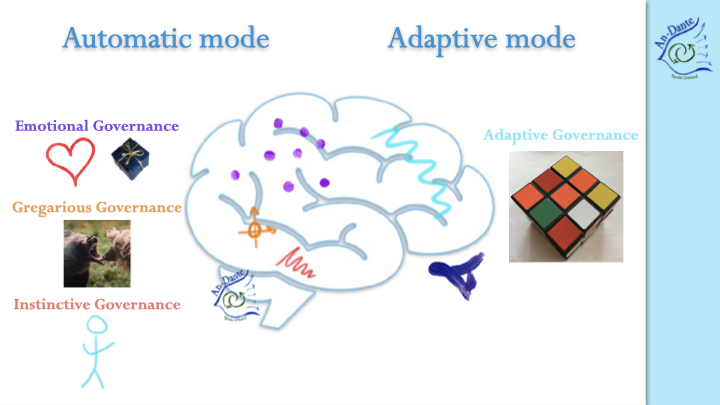
That said, our brain exhibits a kind of functional heterogeneity: the instinctive, gregarious, and emotional governances are automatic, meaning they activate on their own.
For example, when we’re stressed, we don’t decide to be—it just happens, and we can only observe it.
The adaptive governance, on the other hand, isn’t automatic. It can only take over if the other governances “hand over control” to it. For instance, if I’m stressed, I can’t access my intuition. I first need to return to a calm state to switch.
Thus, we need to learn to consciously shift from the automatic mental mode to the adaptive mental mode. This is also what’s referred to as stepping back or gaining perspective.
The Behavioral Dynamics Profile provides an indication of our ability to shift into this adaptive mental mode.
This capacity can be developed, partly through education and partly through training exercises.
Notre cerveau fonctionne en activant les connexions entre les neurones, qui transmettent des informations, à travers ce réseau très dense et complexe. Concrètement, de nombreuses informations sont transmises à différents endroits de notre cerveau.
On sait aujourd’hui que certains territoires sont spécialisés dans certaines fonctions, comme par exemple le fait de parler, ou encore d’avoir peur, de mémoriser, de jouer du violon, de chanter…
On sait également, que le cerveau est en évolution tout au long de la vie, on parle alors de plasticité cérébrale.
En même temps, ces territoires ne fonctionnent pas séparément, l’un après l’autre, ou comme des systèmes indépendants, côté à côte. Cela dit, lorsque nous avons peur par exemple, une zone du cerveau est plus particulièrement active. Et c’est la même zone pour deux individus différents qui ont peur, cela quelles que soient leur culture, langue ou origine. Pour caractériser ce fonctionnement, on parle de Gouvernance cérébrale.
Qu’est-ce que la Gouvernance ?
C’est un peu comme pour un orchestre de Jazz ou de musique traditionnelle : les instrumentistes jouent tous ensemble un thème, au même rythme, sur la même harmonie.
A un moment, l’un des instruments démarre un solo. Par exemple le saxo. Alors souvent le saxophoniste se lève, et surtout on entend son instrument qui « passe au dessus » des autres. Les autres instruments continuent à jouer, à accompagner, et, en même temps, on entend plus particulièrement le saxo. Et à ce moment-là, c’est lui qui « mène la danse » : il choisit le tempo, il peut changer l’harmonie, voire même le thème, il réalise des improvisations et les autres lui emboitent le pas. C’est lui qui gouverne.
Puis, il reprend sa place et un peu plus tard, c’est le solo de la contrebasse, et ainsi de suite. Les gouvernances alternent.
Finalement pour notre cerveau, c’est un peu pareil.
A certains moments, nous ressentons de la peur par exemple, notre cerveau passe en gouvernance instinctive, et puis lorsque la situation a évolué, nous nous sentons détendus et pleins d’imagination. C’est une autre gouvernance qui est à l’oeuvre, dans cet exemple, la gouvernance adaptative.
L’Approche Neurocognitive et Comportementale développée par l’IME (Institut de Médecine Environnementale) distingue quatre type de gouvernances :
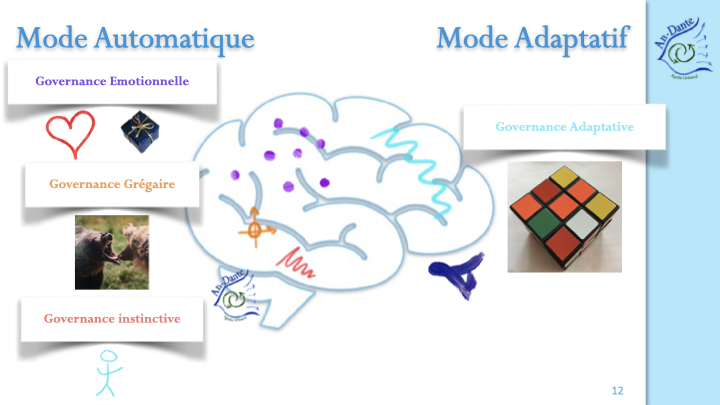
Cela dit, notre cerveau présente une sorte d’hétérogénéité de fonctionnement : les gouvernances instinctive, grégaire et émotionnelle sont automatiques, c’est à dire qu’elles se déclenchent toutes seules.
Par exemple, quand nous sommes stressés, nous ne l’avons pas décidé, nous pouvons juste le constater.
La gouvernance adaptative, elle, n’est pas automatique. Elle ne peut gouverner que si les autres gouvernances lui « passent la main ». Par exemple, si je suis stressée, alors je n’accède pas à mon intuition. je dois d’abord revenir au calme pour basculer.
Il nous faut ainsi apprendre à basculer consciemment du mode mental automatique au mode mental adaptatif. C’est aussi ce que l’on nomme la prise de recul.
Le Profil de dynamique comportementale donne une indication de notre capacité à basculer en mode mental adaptatif.
Cette capacité se développe, d’une part par l’éducation, d’autre part via des exercices d’entrainement.
On parle beaucoup de l’intelligence collective, à la base de l’équation contre intuitive de 1+1=3.
De quoi s’agit-il ? et comment la mobiliser ?

L’intelligence est connue chez les individus, elle est notamment mesurée par le Quotient Intellectuel, mais ne leur est pas réservée. Elle se développe également dans certains groupes. Alors comment faire pour qu’un groupe fasse mieux qu’une somme d’individus ? Comment transformer une équipe de personnes ayant diverses expertises en une équipe experte et efficace ?
Pour les psychologues sociaux[1], les facteurs suivants influent :
Les tâches peuvent être :
Pour ces différentes tâches, les niveaux de coordination et d’interdépendance sont différents.
Les règles de fonctionnement favorables à l’émergence de l’intelligence collective :
Je vous invite à profiter de cet article pour partager votre expérience et vous enrichir des autres contributeurs !
[1] recherches d’Anita Wooley, Université Carnegie-Melle de Pittsburg USA
La Communication Non Violente CNV ou Communication Bienveillante est une technique de communication qui permet de résoudre de nombreux conflits relationnels.
Elle permet, en outre, de travailler son assertivité. L’assertivité est le fait de se positionner, sans être ni dans l’agressivité, ni dans la manipulation, ni dans la fuite.
Sa limite est celle d’une relation où la manipulation ou la mauvaise foi prennent la main. Alors ce n’est pas la bonne technique, car le propre de la manipulation est justement de manipuler l’autre émotionnellement.
Nonviolent Communication (NVC) or Compassionate Communication is a communication technique that helps resolve many relational conflicts.
It also supports the development of assertiveness, which means expressing yourself clearly and confidently without aggression, manipulation, or avoidance.
However, NVC has its limits—specifically in relationships where manipulation or insincereness dominate. In such cases, it may not be the right approach, as manipulation itself is designed to emotionally control the other person.

Elle se fait en 4 étapes :
Par exemple :
Autre exemple :
A une demande, l’autre personne est libre de répondre par l’affirmative, ou pas. Une négociation peut commencer si les deux interlocuteurs sont dans cette qualité d’échange.
Ce qui peut également placer l’échange sur ce terrain, est de rappeler avant la première étape, ce qui est important dans la relation, ce qui la nourrit. Ainsi l’interlocuteur ouvre ses oreilles et son coeur, et son intelligence émotionnelle est sollicitée.
Autre point de vigilance important pour une CNV efficace : faire des phrases courtes, épurées, directes, afin de ne pas perdre l’attention de l’autre.
Comme on est dans une émotion forte, on a souvent tendance à « tourner autour du pot ». Cela dit, si l’intention est bienveillante, et hors de relation de manipulation, le message a toutes ses chances de porter. Et au pire, on reçoit un non à sa demande. Et on a augmenté ses chances d’être entendu·e à la prochaine demande.
Pour formuler une demande claire et donc audible, il faut être conscient des ses émotions, de ses jugements et de son besoin, présents ici et maintenant, alors utilisez les mindmaps des Emotions, des Besoins et des Jugements ! Ce sont des bases de données précieuses pour s’entrainer en CNV et en Intelligence Emotionnelle.
Nonviolent Communication (NVC) in 4 Steps
Example 1:
Example 2:
A Request is Not a Demand
The other person is free to agree or not. If both people engage in a genuine exchange, a negotiation can follow.
To create an open and constructive conversation, it helps to start by reminding the other person what is valuable in the relationship, what strengthens it. This encourages them to listen with both their ears and their heart, engaging their emotional intelligence.
Key Tips for Effective NVC
Tools to help with this:
Use ressources on Emotions, Needs, and Judgments—they are great resources for practicing NVC and strengthening Emotional Intelligence.

Nous vivons une situation sans précédent.
Monsieur de La Palisse sors de ce corps !!!
Comment faisons nous, individuellement et collectivement face à cette réalité ?
La situation de confinement nous renvoie à des situations inédites, avec lesquelles nous devons composer, comme par exemple :
Nous voilà face à face avec nous-mêmes et avec nos peurs.
Vous entendez la musique de « Mission Impossible » en fond sonore ?
La base, sur laquelle, nous nous appuyons habituellement est totalement bouleversée.
A cette situation, nous ne pouvons rien changer, rien d’autre… que notre façon de la percevoir et de la vivre.
C’est juste én-or-me !!!
Alors je vous propose quelques questions pour en apprendre quelque chose de vous-même, des relations avec vos proches, avec vos contacts professionnels et vos communautés.
Pendant cette période de confinement :
Je peux aussi vous accompagner individuellement et en équipe, par visio-conférence, pratique que j’utilise avec mes clients depuis qu’une première cliente m’a fait sauter ce pas, il y a 5 ans ;-).
Depuis ce jour, je la remercie à chaque connexion !
Pour réserver un entretien par téléphone ou visio : welcome @ an-dante.fr ou par sms si vous avez déjà mes coordonnées.
in English below
La dynamique comportementale est la signature de notre façon de penser, ressentir et nous comporter, dans les situations simples ou complexes, connues ou inconnues.
Le Profil de Dynamique Comportementale est un outil qui permet, en partant d’une meilleure connaissance de soi et des autres, d’élaborer les évolutions souhaitées, de se mettre en marche vers plus de connaissance de ses modes de fonctionnement -ainsi que ceux d’autres humains-, trouver un meilleur équilibre plaisir-effort et ainsi, plus de performance.
Des exemples d’applications :
« Ce test m’a permis de découvrir de nouvelles facettes de mon profil et d’en confirmer d’autres, le tout avec beaucoup de nuances. Surtout, il m’a permis de mieux comprendre mes leviers de motivations, ce qui me met en mouvement ou à l’inverse, ce qui me coûte de l’énergie. »
« Les résultats sont très précis, et nuancés, c’est super intéressant, je suis vraiment impressionné… et maintenant, je sais où je vais ! »
« Maintenant, je comprends où ça bloque pour moi, j’ai envie de poursuivre par du coaching pour m’épanouir et me développer »
« Je me reconnais dans la facette de motivation du novateur, et je sais qu’une fois que j’ai trouvé une solution à un problème complexe, ça ne m’intéresse pas tellement de passer à la mise en oeuvre, alors je choisis un bras droit qui a cette ressource là, qui a la facette gestionnaire ! »
« Très instructif, beaucoup de découverte de soi et de compréhension des différents comportements. »
« Ce modèle permet de s’interroger sur son mode de fonctionnement et ses pratiques, de façon concrète. »
» Quand ça va mal, je descends à l’atelier, parler avec des vraies gens, les aider à résoudre leurs problèmes, et ensuite, ça va mieux et je remonte ! Maintenant je comprends pourquoi ça me fait du bien. Et je vais continuer, quoi qu’on en dise ! »
« Cette approche va me conduire à apprendre à analyser « l’autre » en situation de travail, en complément de mon auto-analyse. »
« Cela nous aide à améliorer nos situations professionnelles au quotidien. »
« Les échanges qui découlent de la présentation des profils de motivation et des freins sont très fournis. »
Il est intéressant de passer un Profil de Dynamique Comportementale lorsqu’on :
Il est utilisé en début de coaching, pour clarifier rapidement les axes de travail du coaching.
Le rapport de Profil de Dynamique Comportementale présente :
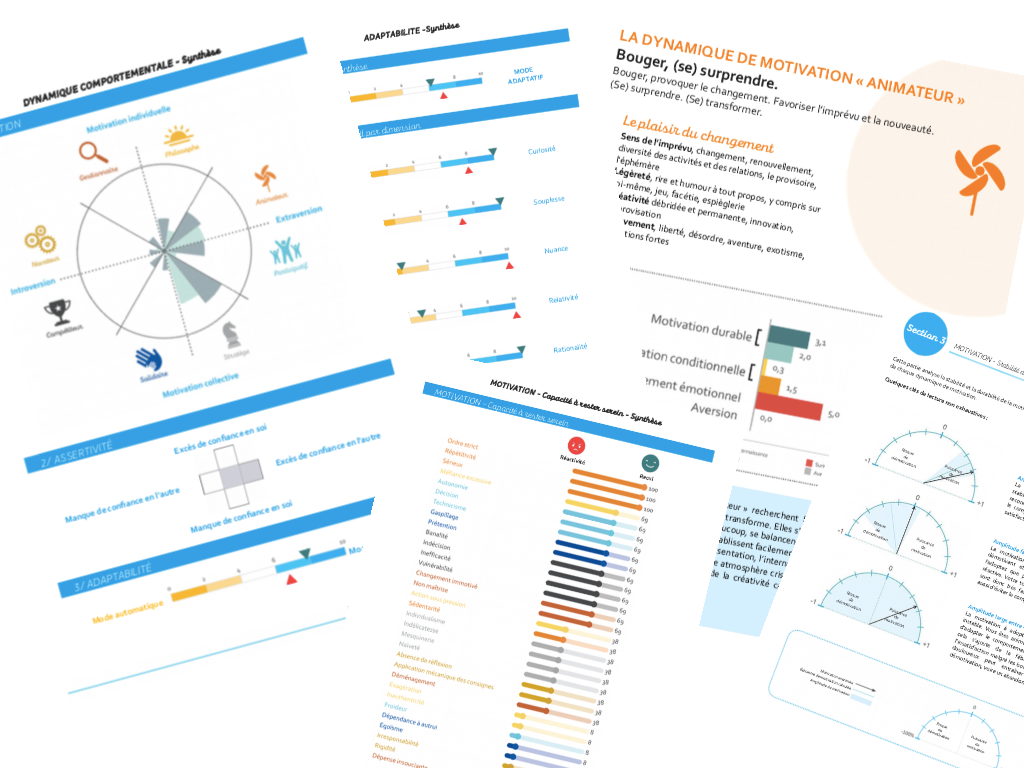
Le questionnaire se passe en ligne (environ une demi-heure). Il donne lieu à un rapport détaillé remis lors d’un débriefing individuel de 2h, par une coach certifiée ANC.
La séance de débriefing a pour objectif de présenter les éléments du rapport et de commencer à faire des liens avec la situation du coaché.
Le questionnaire est fondé sur l’Approche Neurocognitive et Comportementale, développée par l’Institut de Médecine Comportementale, qui mène depuis plus de 30 ans des recherches interdisciplinaires et les transfère aux situations des entreprises et organisations.
Behavioral dynamics are the signature of how we think, feel and behave, in simple or complex situations, known or unknown.
The Behavioral Dynamics Profile is a tool that allows, starting from a better knowledge of oneself and others, to design the desired evolutions, to move towards more knowledge of one’s modes of operation -as well as those of other humans-, to find a better balance pleasure-effort and thus, more performance.
Examples of applications:
« This test allowed me to discover new facets of my profile and confirm others, all with a lot of nuance. Above all, it allowed me to better understand my motivational levers, what puts me in motion or on the contrary, what costs me energy. »
« The results are very precise, and nuanced, it’s super interesting, I’m really impressed… And now I know where I’m going! »
« Now I understand what gets in the way for me, I want to continue with coaching to flourish and develop myself »
« I recognize myself in the motivating side of the innovator, and I know that once I have found a solution to a complex problem, I am not so interested in moving on to implementation, so I choose a right arm who has this resource, who has the management facet! »
« Very informative, a lot of self-discovery and understanding of different behaviors. »
« This model makes it possible to question its mode of operation and its practices, in a concrete way.»
« When things go wrong, I go down to the workshop, talk to real people, help them solve their problems, and then it gets better and I come back upstairs! Now I understand why it makes me feel good. And I will continue, no matter what people say! »
« This approach will lead me to learn to analyze the « other » in a work situation, in addition to my self-analysis. »
« It helps us to improve our daily professional situations. »
« The exchanges that result from the presentation of motivation profiles and obstacles are very extensive. »
It is interesting to pass a Behavioral Dynamics Profile when you:
It is mostly used at the beginning of coaching, to quickly clarify the goals of coaching.
The Behavioral Dynamics Profile report presents:
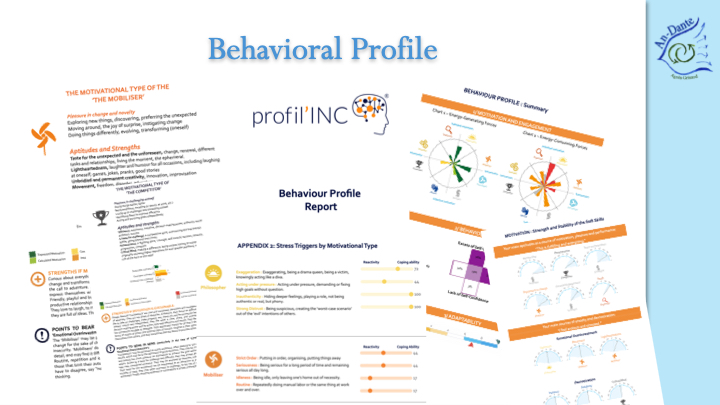
The questionnaire takes place online (about half an hour). It produces to a detailed report delivered during a 2-hours individual debriefing, by an ANC certified coach.
The purpose of the debriefing session is to present the elements of the report and to begin to make links with the coachee’s situation.
The questionnaire is based on the Neurocognitive and Behavioral Approach, developed by the Institute of Behavioral Medicine, which has been conducting interdisciplinary research for more than 30 years and transferring it to the situations of companies and organizations.