« La perfection c’est faire du mieux que je peux au moment où je le fais. » – Aline de Petigny
« Do the best you can until you know better. Then when you know better, do better. » – Maya Angelou.


Team & Leader Performance via Harmonized Relationship
Article in English below
Quel que soit l’individu, une situation où les moyens pour répondre à une exigence ne sont pas disponibles, est génératrice de stress.
Que faites-vous lorsque vous constatez qu’on exige de vous plus que ce dont vous avez les moyens ?
Autrement dit, lorsque vous avez des responsabilités qui excèdent vos ressources ou votre pouvoir d’action ?
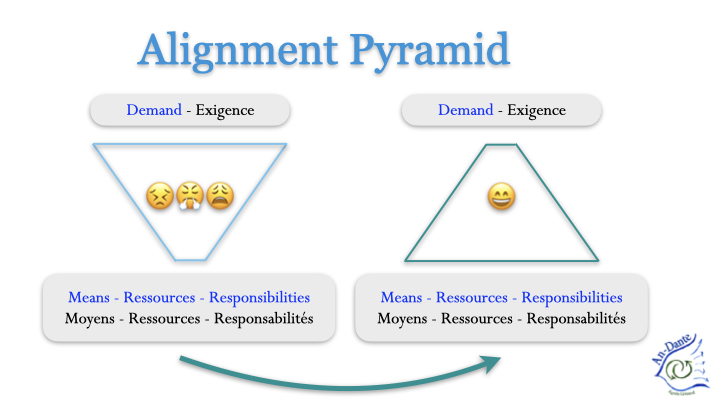
Pour retrouver son calme, ou inverser la pyramide, qui passe alors d’un équilibre instable à un équilibre stable, la méthode smart est précieuse.
Dans la relation à soi ou à l’autre, la question de l’exigence est souvent en jeu.
La méthode SMART permet à l’individu de se donner les moyens de répondre aux attentes, qu’elles soient vis à vis de soi-même ou d’une source extérieure, ou encore de transformer une exigence en un objectif avec des éléments concrets et réalisables.
Une personne en charge de la direction d’une d’entreprise -ou d’une Business Unit- se sent sous pression, face à la multitude d’urgences à gérer. Le déficit de temps face aux flux des urgences sans cesse renouvelé est une source de stress intense en sans fin. S’y ajoute le manque de temps pour piloter l’entreprise qui génère de l’insatisfaction et l’éloignement du sens dans la fonction de direction.
S : je me réserve du temps en priorité à toutes les autres tâches
M : ce temps est mesurable en heures, et a postériori je vois si je l’ai effectivement réalisé
A : je peux disposer de mon temps en autonomie
R : je réserve quelques heures par semaine
T : mon temps de « cabine de pilotage » est dans l’agenda, toutes les semaines
Effets secondaires positifs : ce rendez-vous avec soi devient indispensable, le cerveau focalise plus rapidement, grâce à la ritualisation du moment dans la semaine. Les urgences sont gérée avec plus de hauteur. Le stress diminue et la capacité de concentration et de prise de décision augmentent.
No matter the individual, a situation where the means to meet a requirement are unavailable generates stress.
What do you do when you realize that more is being demanded of you than what you have the means to handle?
In other words, when your responsibilities exceed your resources or your ability to act?
To come back to calm or to reverse the pyramid—shifting from an unstable to a stable balance—the SMART method is invaluable.
In our relationship with ourselves or others, the issue of demands often comes into play. The SMART method allows individuals to offer themselves means to meet expectations, whether self-imposed or coming from an external source. It also helps transform a demand into a goal with concrete and achievable elements.
SMART Method:
1. S is for Specific – clear and precise.
2. M is for Measurable – quantifiable.
3. A is for Attainable – realistic and achievable.
4. R is for Relevant – meaningful and realistic.
5. T is for Time-bound – linked to a deadline.
A person in charge of running a company—or a Business Unit—feels under pressure due to the constant stream of urgent matters to handle. The lack of time to keep up with these ever-renewing urgencies creates intense and endless stress. On top of that, the inability to dedicate time to steering the business leads to frustration and a disconnect from the deeper purpose of leadership.
Applying the SMART Method:
S (Specific): I prioritize setting aside time before any other tasks.
M (Measurable): This time is tracked in hours, and I can later assess whether I actually followed through.
A (Attainable): I have the autonomy to manage my own time.
R (Relevant): I reserve a few hours per week.
T (Time-bound): My “cockpit time” is scheduled in my calendar every week.
Positive Side Effects:
This self-appointment becomes essential, helping the brain focus more quickly due to the ritualization of the practice. Urgent matters are handled with greater perspective, stress decreases, and both concentration and decision-making ability improve.
Confinement. Couvre-feu. Incertitudes. Pandémie. Conflits armés.
Que vous les perceviez comme des éléphants dans la pièce ou comme des gaz invisibles et pourtant bien présents, ces éléments ont un impact. Impact individuel, impact collectif.
Au regard de mes conversations de coaching, je constate que cet impact comporte un point commun : nous faire réagir, de manière instinctive. Chacun à notre manière. Cette réaction, naturel élan de survie, n’est pourtant pas la plus efficace, ni la plus adaptative, dans des situations complexes.
Alors comment nous (re)mettre en mouvement ? Sortir de cette ornière où la pandémie nous pousse insidieusement ? Comment nous (re)connecter à notre créativité, afin de trouver des stratégies d’adaptation face à tous ces éléments que nous vivons, afin de vivre sans subir ? Afin de vivre plutôt que de sur-vivre ?

En ce début de nouvelle année, au démarrage d’un nouveau cycle, je vous propose un exercice pour imaginer votre prochain voyage.
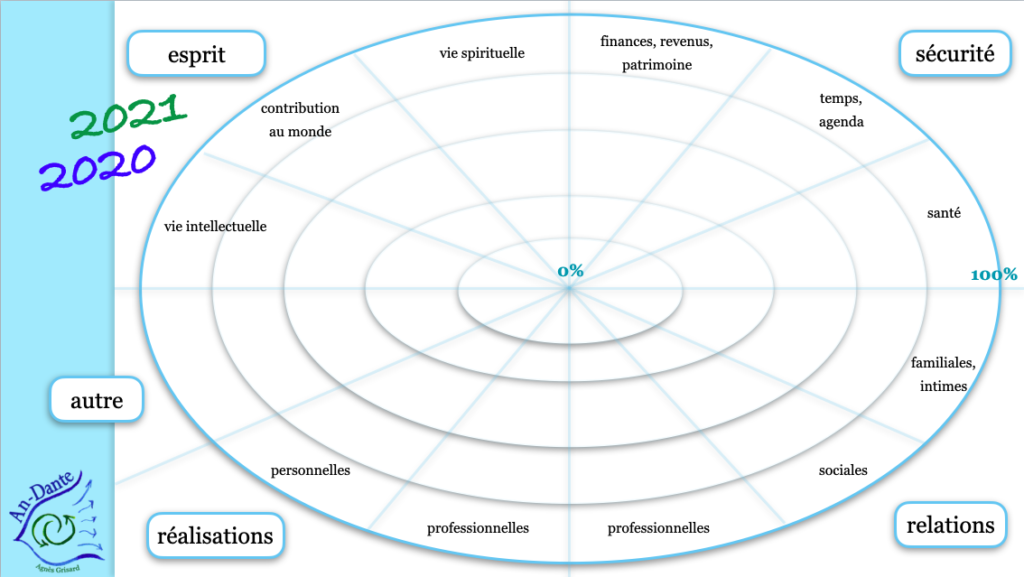
On the eve of this year, at the beginning of a new cycle, here is an exercise to imagine your next journey.
article in English below
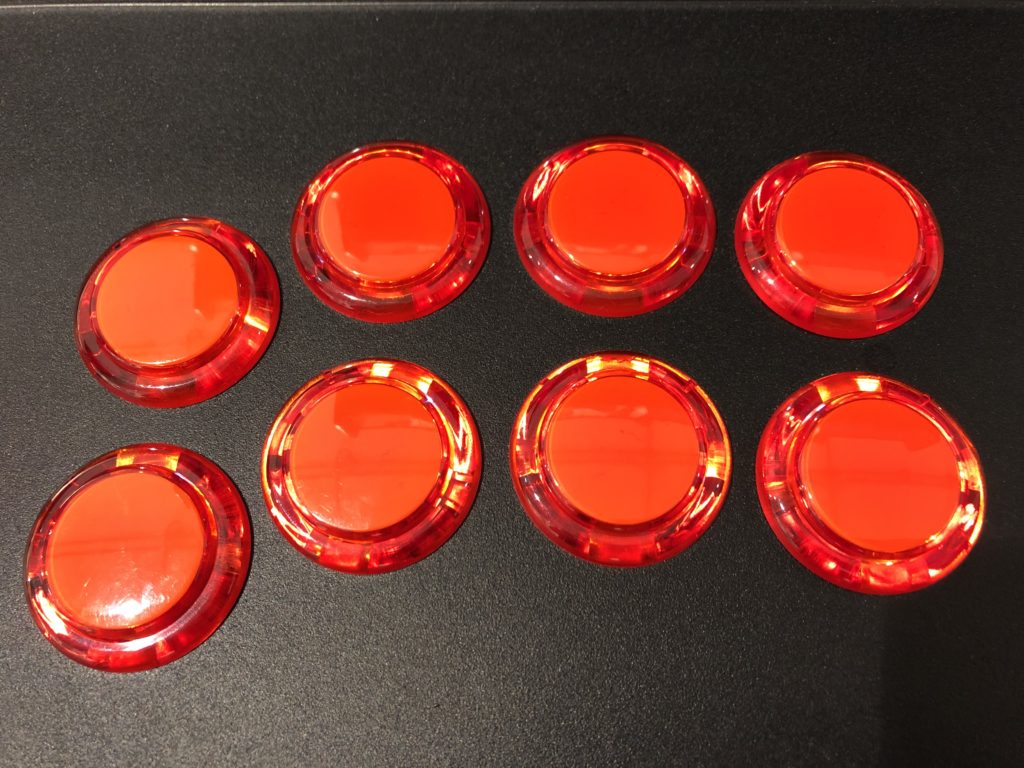
Les « boutons rouges » sont les intolérances qui nous déclenchent émotionnellement, à chaque fois que quelqu’un appuie dessus ou une situation nous y confronte.
Ces réactivités sont à l’origine de bien des conflits dans les équipes.
The « red buttons » are the intolerances that trigger us emotionally, every time someone presses them or a situation confronts us.
These reactivities are at the root of many conflicts in teams.
Leur effet est de nous faire sur-réagir à la situation, ce dont nous sommes peu conscients au moment où cela est déclenché, et que nous pouvons observer par analyse réflexive, après coup. Leur déclenchement nous fait basculer en mode instinctif, où nous réagissons en défense, sur un mode très automatique et rarement adapté à la situation.
Par exemple, une équipe en conflit, découvre lors d’un coaching que le conflit est alimenté par des intolérances individuelles : ne pas être reconnu·e comme à la hauteur, recevoir des ordres, rendre un rapport incomplet ou imparfait, être impuissant·e à calmer deux collègues…
Pour développer notre Leadership Complexe, il est utile de les connaitre, et d’apprendre à les gérer, d’abord pour soi, puis dans la relation.
Their effect is to make us overreact to the situation, which we are little aware of at the time it is triggered, and which we can observe by reflexive analysis, after the fact. Their triggering makes us switch to instinctive mode, where we react in defense, in a very automatic mode and rarely adapted to the situation.
For example, a team in conflict, discovers during a coaching that the conflict is fueled by individual intolerances: not being recognized as up to the task, receiving orders, making a report incomplete or imperfect, being powerless to calm two colleagues…
To develop our Complex Leadership, it is useful to know them, and to learn to manage them, first for oneself, then in the relationship.
Article in English below
Dans ce article, nous vous proposons une plongée dans le monde des émotions, pour mieux les comprendre, et mieux les apprivoiser !
In this article, we invite you to dive into the world of emotions to better understand and embrace them!

« Le stress n’est pas une émotion mais bien l’effet d’une compression que les exigences extérieures imposent à nos émotions. Ce qu’il faut ce n’est donc pas éliminer le stress : c’est être en contact avec nos émotions et nous servir de l’information qu’elles contiennent pour agir sur le stress en tenant compte de nos besoins. » Michèle Larivey.
“Stress is not an emotion but rather the effect of pressure that external demands impose on our emotions. The goal is not to eliminate stress but to stay in touch with our emotions and use the information they provide to address stress while considering our needs.” — Michèle Larivey.
En d’autres mots, le stress nous donne une information que quelque chose « bug » dans notre cerveau ! Ou du moins dans notre façon de percevoir la situation. Cette information est constituée notamment de nos ressentis et émotions. A nous d’en faire quelque chose pour changer la situation et nous transformer. Dans l’instant. Et c’est aussi un travail qui porte sur le long terme.
En voici des clefs concrètes.
Nos apprentissages sur la vie émotionnelle, nous viennent de notre famille et notre culture. Ca, c’est fait !
Cela dit, bonne nouvelle : nous pouvons poursuivre nos apprentissages toute notre vie !
Sentiment : sans sensation corporelle forte, durable, délicat et subtile
Émotion : avec sensation corporelle plus ou moins intense, non durable, envahissante, réaction intérieure vive avec une intensité
Expérience émotive : résultat du processus d’experiencing, faite d’émotions, des sensations qui en découlent, des pensées. Se centrer, c’est porter son attention sur l’expérience immédiate pour l’accueillir et y accéder.
Les émotions ou les sensations sont un signal de ce que nous vivons. En qualité et en intensité. Ce signal a une signification subjective, lié à notre système de pensée individuel, et elle renvoie à un besoin, dans l’instant présent.
Les sensations nous parviennent par nos cinq sens vue, ouïe, toucher, odorat, goût, et le mouvement.
Les émotions sont au cœur de notre système de communication. Les émotions sont décrites par les mots que nous leur affectons et les sensations qui leur sont liées. Par exemple, si j’ai peur, je relie ce mot à la sensation d’avoir le coeur qui accélère, le souffle court, la voix chevrotante et peut-être aussi une salivation différente (en plus ou en moins)
Plus nous sommes capables d’exprimer et d’extérioriser nos émotions, plus le contact avec nous est enrichissant pour ceux qui nous côtoient. Nous leur donnons ainsi accès à notre vie intérieure. Et ce que nous vivons les concerne souvent.
Michèle Larivey scinde les émotions en 4 catégories (que l’on retrouve également peu ou prou chez d’autres auteurs) :
Chacune des émotions simples rend compte d’un besoin. Elle est donc la clef d’accès au besoin et la satisfaction de celui-ci éteint l’émotion qui n’a alors plus besoin de se manifester puisque le besoin est comblé.
Certaines émotions se manifestent par rapport au responsable ou à l’obstacle, telles que l’amour, l’affection, la fierté. Le besoin peut alors être plus enfoui.
Les émotions d’anticipation concernent ce qui pourrait survenir. Elle sont le fruit de notre imagination, telles que l’excitation, l’appétit, l’inquiétude, la peur, le trac. Elles sont aussi des indicateurs de nos besoins sous-jacents.
Quand un besoin est satisfait, le système est à l’équilibre. Quand il n’est pas satisfait ou qu’un nouveau besoin apparaît, le système est en déséquilibre. Chez l’humain, le besoin est physique -exemple la soif : besoin d’eau- et psychologique -et peur : besoin de protection-.
L’émotion nous signale donc à quel point nos besoins sont satisfaits ou non.
Et chacun.e est responsable de la satisfaction de ses propres besoins.
Le travail sur les émotions consiste à faire des allers-retours entre le ressenti d’une sensation corporelle, et des mots précis pour nommer l’émotion. Cela nous permet d’accéder à la compréhension de ce que nous vivons.
Cette expérience de boucle du processus émotionnel s’enrichit au fur et à mesure de la pratique. Et cet entrainement augmente notre intelligence émotionnelle.
Le processus naturel de croissance, ou processus vital d’adaptation, se déroule en 5 phases :
Ci-après, vous trouverez, par émotion, les caractéristiques de l’émotion, du sentiment ou d’un autre signal, et l’intérêt de ce signal. Ce sont des pistes pour clarifier ce que vous pourriez faire de ces signaux.
Nos émotions sont des signaux de notre intelligence et des manifestations que nous sommes vivants et en mouvement.
Alors et si nous apprenions à les entendre et à nous servir d’elles comme levier de développement dans la relation à nous-même et aux autres ?
In other words, stress gives us information that something is “glitching” in our brain—or at least in how we perceive a situation. This information consists of our feelings and emotions. It’s up to us to do something with it—to change the situation and transform ourselves, both in the moment and in the long term.
Here are some practical keys to understanding and managing stress.
Our emotional learning comes from our family and culture. That part is already set. But the good news is that we can continue learning throughout our entire lives!
Feeling : does not involve strong bodily sensations, subtle, delicate, and long-lasting.
Emotion : involves bodily sensations of varying intensity, temporary, can be overwhelming, intense inner reaction.
Emotional Experience
It is the result of an internal process that includes emotions, the sensations they produce, and our thoughts. Focusing on emotions means paying attention to the immediate experience, accepting it, and accessing its deeper meaning.
Emotions and sensations signal what we are experiencing—both in quality and intensity. These signals are subjective and tied to our personal thought systems. They point to an unmet need in the present moment. Our sensations come through our five senses (sight, hearing, touch, smell, taste) and movement. Emotions are at the core of human communication. They are expressed through both words and the physical sensations they trigger.
For example, if I feel afraid, I might notice my heart racing, shortness of breath, a shaky voice, changes in saliva production.
The more we can express and externalize our emotions, the more meaningful our interactions become. Sharing our inner world allows others to understand us—and often, what we feel affects them too.
Psychologist Michèle Larivey classifies emotions into four categories (a system echoed by other experts as well):
Positive simple emotions indicate satisfaction and are linked to the instinctive calm response described in neuroscience.
• Pleasure
• Joy
• Delight
• Affection
• Pride
• Love
Negative simple emotions indicate dissatisfaction and are linked to the neurosciences instinctive governance fight-or-freeze.
• Boredom
• Sadness
• Disappointment
• Melancholy
• Disgust
• Pain
• Anger
• Rage
• Impatience
• Frustration
Each simple emotion is connected to a need. Once the need is met, the emotion naturally fades. Some emotions relate specifically to a person or obstacle, such as love, affection, or pride. These emotions may point to deeper, hidden needs.
These are emotions about what might happen. They come from our imagination and help reveal underlying needs, like excitement, appetite, anxiety, fear, stage fright. They are also signs of unsatisfied needs.
Mixed emotions mask deeper issues and require careful analysis.
• Guilt
• Jealousy
• Contempt
• Pity
• Disgust
• Shame
Counter-Emotions
These are physically intense emotions that reveal what we suppress or try to avoid. They are linked to the flight instinctive governance.
• Anxiety
• Panic
• Nervousness
Pseudo-Emotions
• Feeling rejected
• Being conflicted about someone you love, feeling trapped, insignificant, or amazing
• Feeling confused, depressed, or emotionally drained
• Behaviors : openness, curiosity, warmness, hostile, judgments (which are not feelt) like stupid, ridiculous, pathetic
When a need is met, we feel balanced. When it isn’t met, or when a new need arises, we feel off balance. Human needs are both physical (e.g., thirst → need for water), psychological (e.g., fear → need for protection)
Our emotions tell us how well our needs are being met.
And importantly: each person is responsible for meeting their own needs.
The key to managing emotions is going back and forth between bodily sensations and specific words to name the emotion.
This process helps us understand what we’re experiencing and improves with practice—strengthening emotional intelligence over time.
1. Emergence – The emotion appears. At first vague, it becomes clearer when we stay present with it. Naming the emotion completes this phase.
2. Immersion – Fully experiencing the emotion without resistance. Many people struggle here, but accepting an emotion as it is allows progress.
3. Development – Understanding its nuances and complexities.
4. Insight – Gaining clarity about why the emotion is there. True insight is a sudden realization, unlike premature explanations that may arise earlier.
5. Unifying Action – Expressing or acting on the insight in a way that aligns with your values. This resolves the emotional cycle and makes space for new experiences.
Each emotion carries valuable information:
Tenderness & Tears
Fulfills an emotional need.
Anger
A sign of imbalance.
Manifests dissatisfaction, a lack, or an unmet need.
Contentment
Satisfaction.
Feel it, surrender to the emotion, and nourish yourself with it.
Desire
An emotion of anticipation, fantasy.
Provides information about a need, an aspiration, a search for balance and satisfaction; a sign of vitality.
Boredom
Lack of meaning.
An unmet need, frustration, passivity; helps identify what truly matters, break free from “shoulds,” reconnect with oneself, and take ownership of one’s choices.
Impatience
Doing something insignificant while neglecting what truly matters.
Indicates that we are wasting time and invites us to invest it in something more meaningful.
Fear
A subjective anticipation of danger.
Encourages us to assess the reality of the danger and take measures to protect ourselves.
Pleasure
Satisfaction of a need, the harmonious fulfillment of a vital requirement.
Indicates that a need has been met.
Sadness
Signals an emotional loss.
Invites us to identify and address this lack, restoring our psychological energy.
Love
A spontaneous emotional movement toward someone who brings us satisfaction and inspires us to surpass ourselves.
Reveals the presence of crucial needs or aspirations, the desire to be recognized for our capacity to attract, and the need for essential validation from the other person.
Healthy Guilt
A deliberate action against my values.
Highlights an internal imbalance or self-disagreement; once clarified, it allows us to take responsibility and make amends.
Guilt of Concealment
Making one’s actions seem more acceptable to oneself and others.
Encourages us to take responsibility for our actions.
Disgust
Weariness, aversion, and disapproval.
Indicates an overload, that we have gone too far.
Pride
A form of self-satisfaction infused with self-esteem.
Indicates that we have taken action up to our standards and invested ourselves in it; may be perceived by others as arrogance or boasting, which invites us to own our achievements and express this emotion openly.
Shame
Social guilt triggered by others’ judgment.
Encourages us to recognize what we struggle to accept about ourselves, clarifies how we judge ourselves, and highlights the importance we place on others’ opinions. Offers an opportunity for personal growth and behavioral freedom.
Jealousy
Anger toward someone who has something I desire.
Through the envy it carries, invites us to identify our own needs and acknowledge our resistance to fulfilling them.
Romantic Jealousy
A mix of fear and anger triggered by insecurity.
Reflects the fear of losing an important benefit from the relationship and insecurity about our attractiveness. Encourages self-confidence development and relationship clarity.
Contempt
• Concealed Contempt: Anger and fear, possibly jealousy, dissatisfaction, a defense against hurt, rejection of the relationship.
• Reactive Contempt: Anger, an admission of disagreement with someone who does not meet our moral expectations, a desire for connection.
Encourages self-exploration to uncover the true cause behind our contempt, leading to acceptance of our vulnerability and honest emotional expression.
Pity
Underlying contempt.
Masks an emotion under socially acceptable appearances, requiring deeper identification.
Fatigue
Excessive emotional expenditure.
A large investment of psychic energy to suppress emotions or fatigue following an intense emotional experience. Signals a need for emotional and physical rest. Encourages opening up to the underlying emotion by breathing and embracing it.
Embarrassment
Occurs when we deny ourselves pleasure or contentment and attempt to replace it with indifference.
Indicates inner conflict between pleasure and its repression due to an inability to fully embrace it or the vulnerability it exposes. Disappears when we accept and openly experience pleasure.
Blushing, Memory Loss, Loss of Focus, Stuttering
An internal struggle between an emerging emotion and the desire to hide it.
Encourages us to accept both the emotion and its expression, embracing ourselves as we are by identifying the emotion seeking to surface and its triggers.
Disappointment
Indicates that an expectation was not met.
Encourages us to clarify our initial expectations and desires, then examine our role and others’ roles in fulfilling them.
Distancing, Withdrawal
Reflects dissatisfaction, frustration, or even anger that remains unexpressed.
Encourages us to express what we feel and embrace the liveliness of the relationship.
Frustration
A state of dissatisfaction, coupled with a sense of injustice, generating anger, jealousy, or sadness.
Encourages us to take an active role in relationships, take charge of our lives, and ensure our needs are met.
Helplessness
Inability or impossibility to take action or achieve goals.
Highlights obstacles preventing satisfaction, urging us to distinguish between what is within our control and what is not. This clarification helps break free from paralysis.
Manipulation
An action imposed on us, pushing us to do things we do not want to do, triggering emotions we resist, making us vulnerable to control.
Encourages awareness of the emotion at play and resistance to manipulation.
Gratitude
A sense of indebtedness to someone who has done us a favor.
Indicates that we have received something valuable, perceived as a privilege. To fully embrace the experience, we must express our gratitude, which fosters a sense of fulfillment and strengthens the relationship.
Our emotions are not obstacles—they are signals. They guide us toward self-awareness and growth.
So, what if we learned to listen to them and use them as tools for personal development and deeper connections?
Nous prenons plusieurs milliers de décisions par jour, un grand nombre d’entre elles de manière automatique et inconsciente ou peu consciente. Comme mettre des lunettes, marcher, respirer…
Que se passe-t-il dans notre cerveau dans le processus de prise de décision ?
Comment se passent nos prises de décision ?
Qu’est-ce qui fait que nos émotions influent sur nos décisions ?
Comment notre capacité de réflexion influe-t-elle ?