
Lors d’un atelier d’improvisation, un imprévu révèle les mécanismes de l’innovation en temps réel : ancrage, mode adaptatif, leadership et rôle clé du premier « Follower ».
During an improv workshop, an unexpected disruption reveals the real-time mechanics of innovation: grounding, adaptive mode, leadership, and the pivotal role of the first “Follower.”
in English below
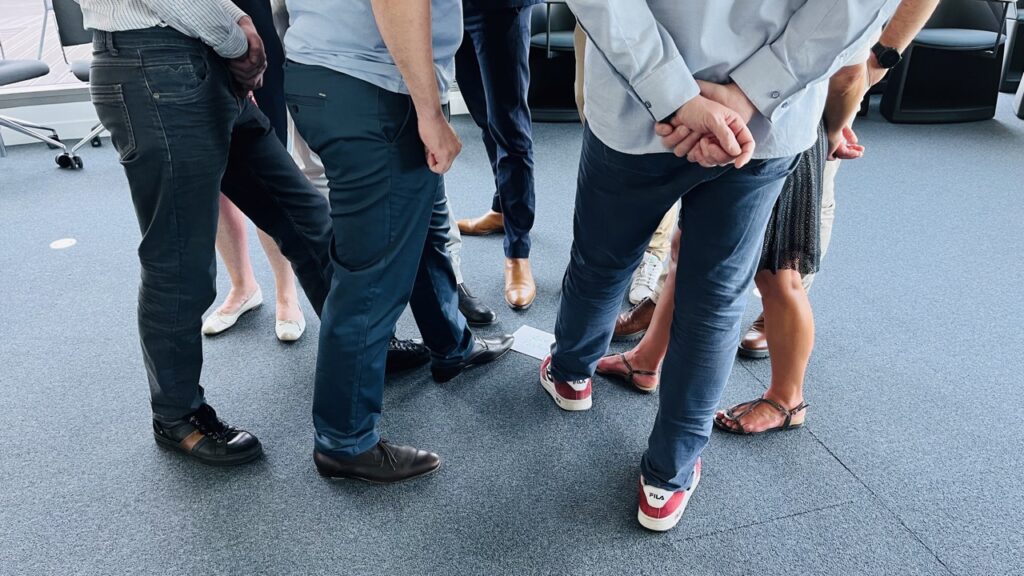
Dernièrement, alors que j’animais un atelier d’improvisation pour un réseau d’ingénieurs, un évènement, totalement inattendu et perturbateur, est survenu.
Vu de l’extérieur, ce comportement inattendu pouvait faire partie de la scénarisation de l’atelier, introduisant une donnée imprévue, pour inviter les participants, et moi la première, à improviser, vraiment ! D’autant que cet imprévu est arrivé pour le groupe après l’exercice d’ancrage et de focus attentionnel.
Dans mon expérience intérieure, j’ai pu observer un double mouvement global et focal. Global avec la connexion au groupe et à l’objectif de l’atelier. Focal avec une partie de mon attention à cet évènement perturbateur.
C’est après la gestion de la perturbation et le retour au calme que j’ai pris conscience réellement de tout ce qui s’était passé. Et à ce moment-là, les signaux émotionnels significatifs d’inquiétude et de résistance à la perturbation, étaient présents.
Après analyse réflexive de cette situation, ce fut, autant pour moi que pour la vingtaine de participants, une expérience en temps réel :
- du mode adaptatif en action : à la fois global et focal, dans une couleur émotionnelle calme et active
- de mes expériences précédentes d’animation d’ateliers ou formations et de coaching d’équipe, avec la gestion de la complexité des groupes, avec des comportements non collaboratifs ou perturbateurs
- de mes expériences de concert, où au-delà de la partition, il y a systématiquement des perturbations inattendues, dans le public, parmi les choristes, de la part du chef…
- de mes formations de coaching d’équipe et de système, qui soutiennent à la fois ma compréhension de ce qui se passe, et les expériences par essai-erreur fructueuses en apprentissages
- de la capacité d’innovation dans l’instant, c’est à dire lorsqu’on fait quelque chose pour la toute première fois
L’innovation s’active lors de la conjonction de plusieurs éléments :
- La disponibilité ou encore la présence dans l’ici et maintenant ou encore l’ancrage
- L’expérience, comme des fondations sur lesquelles l’édifice peut s’appuyer
Elle est nourrie à la fois par :
- des dimensions cognitives, observer, donner du sens, prendre des décisions de manière consciente
- et également par des dimensions corporelles, s’appuyer sur la stabilité, ou au contraire, bouger, se mettre en mouvement
Ce qui a vraisemblablement soutenu le groupe dans ce passage avec perturbation, a été de trois ordres :
- percevoir mon calme, le maintien du cadre et de la sécurité des participants,
- l’acceptation de la perturbation dans les limites de la sécurité du groupe
- et le maintien du fil conducteur de l’atelier
Un élément déterminant a également été le premier “Follower” : une personne qui a renforcé les limites que je venais de contractualiser avec le groupe en tant que Leader, puis d’autres Followers qui ont amplifié le renforcement. L’individu perturbateur s’est donc retrouvé isolé et s’est adapté à la longueur d’onde du groupe autant que c’était possible à ce moment-là.
Questions réflexives
- à quelles situations réussies d’innovation pouvez-vous vous connecter ?
- qu’est-ce qui vous a aidé dans cette situation précise ?
- quels sont vos apprentissages a postériori ?
Recently, while I was facilitating an improv workshop for a network of engineers, a completely unexpected and disruptive event occurred.
From the outside, this unexpected behavior could have looked like part of the workshop’s design—introducing an unplanned variable to invite participants, myself included, to truly improvise! Especially since this disruption happened right after the group’s grounding and attentional focus exercise.
In my inner experience, I observed a dual movement: both global and focal. Global, through my connection to the group and to the workshop’s objective. Focal, with part of my attention on the disruptive event itself.
It was only after managing the disruption and returning to calm that I truly became aware of everything that had happened. And at that moment, emotional signals—significant concern and resistance to the disruption—were present.
After reflective analysis of this situation, it turned out to be, for me as much as for the twenty or so participants, a real-time experience of:
- the adaptive mode in action: both global and focal, within a calm yet active emotional tone
- my previous experience facilitating workshops or trainings and team coaching, dealing with group complexity and non-cooperative or disruptive behaviours
- my performance experience as a singer, where beyond the musical score itself, unexpected disruptions systematically occur—from the audience, fellow singers, or even the conductor…
- my training in team and systems coaching, which supports both my understanding of what’s happening and fruitful trial-and-error learning experiences
- the capacity for innovation in the moment—in the sense of doing something for the very first time
Innovation is activated when several elements come together:
- availability, or presence in the here and now, or groundedness
- experience, like a foundation on which the structure can rest
It is fed both by:
- cognitive dimensions: observing, making sense, making conscious decisions
- embodied dimensions: relying on stability, or conversely, moving, setting oneself in motion
What most likely supported the group through this disruptive passage was threefold:
- perceiving my calm, and the maintaining of the frame and the participants’ safety
- accepting the disruption within the limits of the group’s safety
- and holding the workshop’s throughline
A determining factor was also the first “Follower“: a person who reinforced the boundaries I had just established with the group as Leader, followed by other Followers who amplified that reinforcement. The disruptive individual was thus isolated and adapted to the group’s wavelength as much as possible in that moment.
Reflective questions
- What successful instances of innovation can you connect this to?
- What helped you in that specific situation?
- Looking back, what are your learnings?