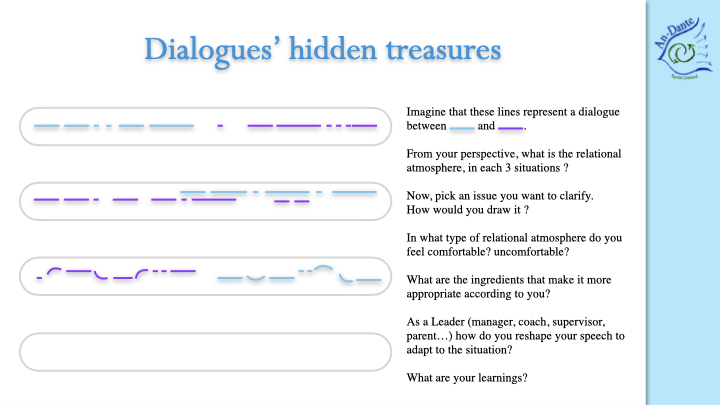
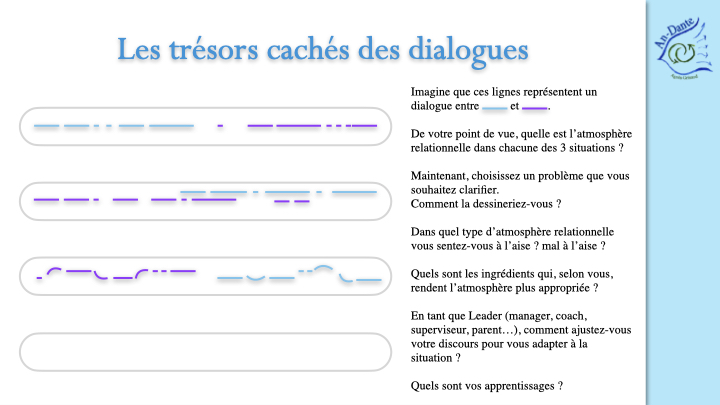
How to get more out of your dialogues, and develop your leadership through your voice, speech pace and words. This self coaching tool is directly drawn from my experience as a choir singer and a relationship systemic coach.
Comment apprendre de vos dialogues, et développer votre leadership, par votre voix, votre prosodie et vos mots. Cet outil d’autocoaching est directement issu de mon expérience de chanteuse en choeur et coach systémique de la relation.
Thanks to a client’s question, here is a process to navigate with a typical toxic relationship situation.
Self Coaching
Once you have read this article, pick one situation where the drama triangle is mostly probable, and unfold what has been going on and how you could improve your own reaction next time.
Remember that to deal with that type of complex relational situation you need to train, fail again, train… and succeed more and more often.
What is this Drama Triangle about ?
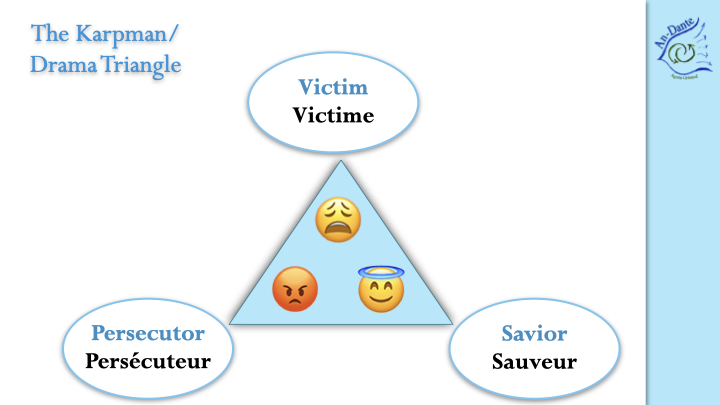
The « Drama Triangle » is a model based on Transactional Analysis and designed by Stephen B. Karpman an American psychiatrist in 1968, unveiling a typical relational scenario with three roles : victim, persecutor and savior.
From a neuroscientific point of view, these three roles are based on automatic modes. And can be analysed as :
the victim being on « flight » or « freeze » mode – either avoidant and frightened, or paralyzed and sad
the persecutor being on « fight » mode – agressive and angry
the savior seeking external acknowledgment of being a good person
Antidotes to the Drama Triangle
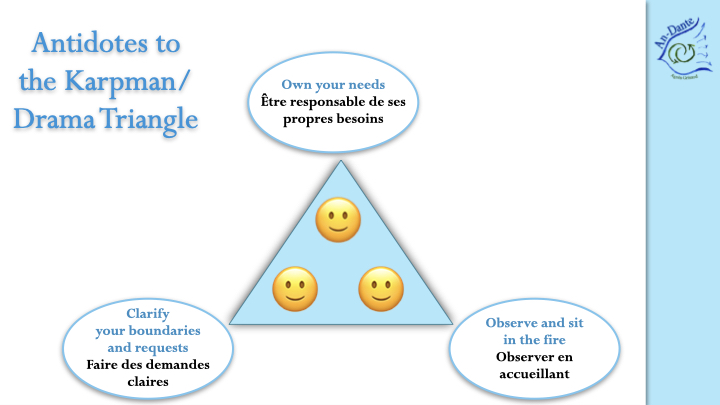
The antidotes to recover freedom out of these automatic modes are :
« Phase 0 » Step back from the game at play :
become conscious that this is a relational game being played, and sort out who is most probably playing what role
in other words : shift your own brain into Adaptive Mode
« Phase 1 » Once you have identified your own role :
antidote for the victim :
recognize their inner feelings, be able to express their needs, take their responsibilities in the situation -vs feeling small or childish, powerless, complaining-
in other words : owning their needs and accepting their own agency on the situation
antidote for the savior :
asking what type of help would be needed, consciously onboarding the risk of not being asked to help -vs helping without having been asked for, and feeling useless-
in other words : sitting in the fire with an observer posture, ready to offer help if asked
antidote for the persecutor :
asking what is needed to solve the problem, in an assertive posture -vs targeting as a victim, controlling, deciding, taking power over-
in other words : setting clear boundaries respectful of other’s boundaries
« Phase 2 » Once you are yourself out of the game you are available to adopt the most appropriate posture toward the two other players :
victim role in flight mode : friendly and openly asking them what they would need to solve the problem, reformulate and help to organize their thoughts
victim role in freeze mode : offering support, recognizing the human skills of the person, and openly asking them what they would need to solve the problem, step by step
savior role : offering the person recognition for them wanting to help, and offering to step back and hold an observer posture, until eventually being asked for help
persecutor role : recognizing the person’s action skills and intelligence, asking them to clarify what action they want to take
Read the article in English : slide to the bottom of this page
J’ai une chance immense dans mon métier : travailler avec des personnes qui cherchent, réfléchissent et sont en quête d’amélioration dans leur situation professionnelle.
Notre travail ensemble est d’aborder ce qui les défie, chatouille, challenge… et n’a pas encore trouvé d’issue, malgré tout ce qu’ils ont déjà tenté.
Dans un espace de prise de hauteur, de changement d’angle de vue, et parfois aussi de challenge.
Une demande qui revient régulièrement : trouver ma place, sortir du sentiment d’être illégitime.
Je vous passe le film en accéléré :
Un travail qui commence par une entrée cognitive, et une demande explicite « je voudrais trouver ma place » dans un système relationnel, puis qui fait émerger autre chose par la manipulation de figurines, et des déplacements dans l’espace, des protagonistes et de l’observateur.
Pour favoriser l’émergence d’autre chose que ce que le client a déjà trouvé par lui-même et qui ne le satisfait pas pleinement, en connectant toutes ses ressources cognitives, émotionnelles et subtiles.
Puis passer au plan d’action concret😉
Votre corps sait ce que votre esprit ignore ou évite.
I am extremely fortunate in my profession: I work with people who are searching, thinking, and striving to improve their professional situations.
Our work together involves addressing what challenges, stimulates, and perplexes them—issues that have yet to be resolved despite all their efforts.
We create a space to gain perspective, shift viewpoints, and sometimes even challenge assumptions.
A recurring request is: finding my place, overcoming the feeling of being illegitimate.
Here’s a fast-forwarded version:
The work starts with a cognitive entry and an explicit request, « I want to find my place » within a relational system. This then evolves into something else through the manipulation of figurines and movement in space by the protagonists and the observer.
This process facilitates the emergence of new insights, beyond what the client has already discovered on their own, by connecting all their cognitive, emotional, and subtle resources.
Are #tools inevitable in professional coaching ? When I think about tools, here is what shows up in my mind : a hammer and a chisel, a milling machine, a laser.
Les #outils sont-ils inévitables dans le coaching professionnel ? Quand je pense aux outils, voici ce qui me vient à l’esprit : un marteau et un burin, une fraiseuse, un laser.
When I hear my clients talk about their experience of tools in coaching, here is what they say…
« My MBTI test says I am « QSDF » I am an introvert I am red and somewhat yellow I am neurodiverse, neurodivergent, hypersensitive and my relatives don’t understand me… »
I so often hear that kind of self statement, when I start a discussion with people trying to negociate a change in their lives, and understand themselves better. To my ear, those words try to sum up what the person has understood from themselves, thought a tool, an assessment, a questionnaire, a personality profile… And triggers my curiosity to discover what is hidden behind this statement.
What are the advantages of tools in supporting people ?
Considering the well known tests (MBTI, DISC…), advantages are simplicity and easy understanding and debriefing. Or even a self use, without specific debriefing skills training. And sometimes also a compulsory step in a company’s training or leadership program.
However, the limits are to fall into human #caricature and #boxing. Plus denial of Human’s #complexity, #richness and #nuance.
So, facing an overabundant and attractive offer of tools, some of them robust, some known worldwide, some innovative, or even « life changing », here are some key safeguard questions :
As a client, what tool is appropriate for you, and what for ?
As a coach, what do you need ? What does your client need ? In a company, the question is often systemic : is your client the contractor, or purchase service, or the Human Ressource service ; or the coachee benefiting the coaching ? What is fuelling your tool supplier ? What is the expected Return On Investment ?
Quand j’entends mes clients parler de leur expérience des outils en coaching, voici ce qu’ils disent…
“Mon test MBTI dit que je suis ‘QSDF’.” “Je suis introverti(e).” “Je suis rouge, avec un peu de jaune.” “Je suis neuroatypique, neurodivergent(e), hypersensible… et mes proches ne me comprennent pas.”
J’entends très souvent ce type d’affirmation lorsque j’entame une discussion avec des personnes qui cherchent à négocier un changement dans leur vie et à mieux se comprendre.
À mes oreilles, ces mots résument ce qu’une personne a retenu d’un outil, un test, un questionnaire, un profil de personnalité… Et cela éveille toujours ma curiosité : qu’y a-t-il réellement derrière cette affirmation ?
Quels sont les avantages des outils pour accompagner les personnes ?
Les tests bien connus (MBTI, DISC…) offrent les atouts de la simplicité, la facilité à comprendre, un débriefing rapide, voire parfois même une utilisation en autonomie, sans formation spécifique. Et parfois, ils sont même intégrés aux formations en entreprise ou aux programmes de leadership.
Cependant, ces outils présentent aussi les écueils de la simplification excessive, la réduction de la personne à une caricature, de mettre les gens dans des boîtes. En plus de nier la complexité humaine, sa richesse et ses nuances.
Alors, face à une offre d’outils surabondante et séduisante—certains scientifiquement solides, d’autres mondialement reconnus, d’autres encore innovants, voire présentés comme “révolutionnaires”—il est essentiel de se poser les bonnes questions :
En tant que client, quel outil est adapté pour vous, et dans quel but souhaitez-vous l’utiliser ?
En tant que coach, de quoi avez-vous besoin ? De quoi votre client a-t-il réellement besoin ? Pour une entreprise, qui est le véritable client ? L’entreprise, le service RH, le service achats, ou la personne coachée ? Qu’est-ce qui motive le fournisseur de l’outil ? Une approche scientifique, une logique commerciale, ou une tendance du moment ? Quel est le retour sur investissement attendu ?
Je me sens raplapla… je manque de peps… le temps me déprime… je manque de lumière ! Certains jours, nous constatons que notre énergie n’est pas au top ! J’observe dans mon équipe, des tensions, le ton qui monte, ou au contraire une forme de désengagement dans la relation, une baisse d’énergie. J’observe dans mon équipe, des tensions, le ton qui monte, ou au contraire une forme de désengagement dans la relation, une baisse d’énergie. Je vous propose un outil pour y réfléchir et vous reconnecter à vos ressources !
I’m feeling drained… low on energy… the weather is getting me down… I need more light! Some days, we just don’t feel at our best. In my team, I notice tension—voices rising—or, on the other hand, a sense of disengagement and low energy in our interactions. I’d like to share a tool to help you reflect and reconnect with your inner resources!
La pyramide à tous ses étages
Cette pyramide est ma compilation de la pyramide de Maslow, remodelée en fonction de mon expérience d’experte de la relation et illustrée pour le plaisir 😉
Abraham Maslow, psychologue américain (1908-1970) a étudié les émotions négatives et leurs corollaires positifs : la motivation et la satisfaction. Ainsi, il a modélisé les différents besoins humains sous forme d’une pyramide.
Schématiquement, l’être humain satisfait graduellement ses différents besoins, ceux du bas de la pyramide devant être satisfaits en premier, afin d’accéder à ceux des niveaux supérieurs.
Selon Maslow, les besoins prioritaires sont les besoins physiologiques, puis les besoins de sécurité et de repères, les besoins de liens sociaux, enfin les besoins d’accomplissement et de réalisation de soi.
Vous avez certainement constaté qu’il vous est compliqué d’être 100% actif dans la journée, si vous n’avez pas suffisamment dormi ou mangé… ou encore quand vous êtes préoccupé par un conflit, un problème insoluble… De même, savoir que l’on va rentrer dans son « home, sweet home » à la fin de sa journée, y retrouver sa famille, son chat… est sécurisant. Les échanges que l’on a pu avoir avec les personnes que l’on a croisées colorent la journée, parfois en gris, parfois en rose ! A plus long terme, les besoins essentiels d’accomplissement et de réalisation sont accessibles lorsque les autres besoins plus prioritaires sont satisfaits.
Cette pyramide de Maslow, qui schématise une hiérarchie des besoins est intéressante à garder en tête, tant pour soi-même que lorsque l’on est en communication avec autrui.
Quand un rouage coince, grince, grippe, une émotion vous alerte sur quelque chose qui vous chiffonne, faites une pause et demandez-vous :
Pyramide Maslow, Mode d’Emploi
ça coince ? OBSERVER avec CURIOSITE
quel signal me renseigne sur le fait qu’il est en train de se passer quelque chose ?
où cela se passe-t-il dans mon corps ?
se POSER, REFLECHIR
quel(s) besoin(s) non satisfait(s) cela pointe-t-il ?
à quel étage ?
où en sont mes besoins aux autres étages de la pyramide ?
AGIR : quelles stratégies mets-je en oeuvre pour satisfaire mes besoins ?
à court terme,
à moyen terme,
à long terme ?
Utiliser ce processus de façon régulière vous permettra d’être plus au clair par rapport à cette question de vos besoins, et au fur et à mesure, vous allez gagner en finesse d’analyse, et vos stratégies seront plus fines, puissantes et efficaces.
Individuellement et en équipe.
Exprimer vos besoins vous permet d’accéder à une communication consciente, d’être assertif-assertive et également plus clair-e pour vos interlocuteurs, qui n’étant pas dans votre cerveau, ne peuvent deviner vos besoins 🙂 !
De même, vous serez mieux à même d’aider les personnes avec lesquelles vous êtes en relation, et de les rendre plus autonomes dans la satisfaction de leurs besoins.
The Pyramid at Every Level
This pyramid is my own adaptation of Maslow’s hierarchy of needs, reshaped based on my experience as a relationship expert and illustrated just for fun 😉
Abraham Maslow (1908–1970), an American psychologist, studied negative emotions and their positive counterparts: motivation and satisfaction. He modeled human needs as a pyramid, showing that people gradually fulfill different levels of needs, starting from the base before progressing to higher levels.
According to Maslow, the most fundamental needs are physiological (food, sleep, etc.), followed by safety and stability, then social connection, and finally self-fulfillment and personal growth.
You’ve probably noticed how hard it is to be fully engaged during the day if you haven’t slept or eaten enough—or if you’re preoccupied with a conflict or an unresolved issue. Similarly, knowing you’ll return to your home, sweet home at the end of the day, to your family or even your cat, provides a sense of security. The interactions you have throughout the day shape your experience—sometimes making it feel bright and positive, sometimes dull or stressful. Over the long term, the essential needs for achievement and self-actualization only become accessible once more immediate needs are met.
Maslow’s hierarchy of needs is a helpful framework—not just for understanding yourself but also for improving communication with others.
Pyramid as a Guide
If something isn’t quite right—if you feel stuck or unsettled—your emotions are sending you a signal. Take a step back and ask yourself:
Maslow’s Pyramid: A Practical Approach
Feeling blocked? OBSERVE with CURIOSITY
What signals are telling me that something is happening?
Where do I feel it in my body?
Pause and REFLECT
What unmet needs is this revealing?
At which level of the pyramid?
How are my needs being met at other levels?
ACT: What strategies can I use to fulfill my needs?
In the short term?
In the medium term?
In the long term?
Using this process regularly will help you develop greater clarity about your needs. Over time, your ability to analyze situations will sharpen, and your strategies will become more precise, effective, and impactful—both individually and within a team.
Expressing your needs allows you to engage in conscious communication, become more assertive, and be clearer with others—who, after all, can’t read your mind!
Likewise, you’ll be better equipped to help those around you, supporting their autonomy in fulfilling their own needs.
Cette approche est précieuse pour des besoins tels que :
CoDir, face à la survie de la société, qui cherche d’autres façons d’embarquer les Leaders du changement
DRH qui veut instaurer des pratiques managériales partagées, émergeant des managers et réellement mises en oeuvre
CoDir et top Managers après la reprise de l’entreprise par le management, qui a conscience de la surcharge globale et veut amener les équipes à identifier les goulots d’étranglement, les zones sensibles et à faire des propositions d’amélioration
La théorie U a été développée par Otto Scharmer enseignant au Massachusetts Institute of Technology, une vénérable et dynamique université américaine de renommée mondiale.
Comment l’utiliser pour innover, sortir de ce qui ne fonctionne pas ou pas suffisamment ?
Gather your Team. Timing depends on the size of your team.
Phase 1
Ask each member for the team to write down what they appreciate in at least 3 of their colleagues. Stand in circle, each member the team receives one by one their colleagues words, fully tasting their flavour, in silence.
Phase 2
Same process, starting with « in 2023, I invite you to increase… »
Phase 3
Same process, writing what they appreciate in the Team. One by one, stick the Post-Its on a board, reading out loud their words.
Phase 4
In the remaining time : How are you going to settle together what has emerged for the Team ?
Vous avez 60 minutes pour votre équipe
Réunissez votre équipe. Le temps de cet exercice dépend du nombre de membres de l’équipe.
Phase 1
Demandez à chacun d’écrire sur des Post-It ce qu’il apprécie chez au moins 3 de ses collègues. En cercle, chacun reçoit tour à tour les mots de ses collègues, en goutant pleinement leur saveur, en silence.
Phase 2
Même processus, en commençant par « En 2023, je t’invite à faire plus… »
Phase 3
Demandez à chacun d’écrire sur un Post-It ce qu’il apprécie dans l’équipe. Chacun vient poser son Post-It sur un tableau pour l’équipe, et annonce à voix haute ce qu’il a écrit.
Phase 4
Dans le temps restant : comment allez-vous, ensemble, ancrer ce qui a émergé ?
Vous avez 10 minutes devant vous – You have 10 minutes for yourself
Phase 1
Settle down with a sheet of paper and a pen -material details are important, because they stimulate better brain connections !- Start a timer for 4 minutes.
Write, continuously, in the flow, -without re-reading or correcting-, starting by » In 2022, I celebrate… » When timer rings, just finish your sentence. Then, during 1 minute, close your eyes, connect to you inner feeling, the circle the 3 most important words to you.
Phase 2
Same process, starting by « In 2023, I wish… » In 30 seconds, connect to you inner feeling, and circle the 3 emerging words
Phase 3
In 30 seconds, write down a sentence with the 6 circled words. Keep this sentence thought 2023, up to the next 10 minutes you will offer your self.
Phase 1
Installez-vous avec une feuille de papier et un stylo -le matériel est important, car il permet de bénéficier des meilleures connexions cérébrales ! -. Déclenchez un minuteur pour 4 minutes. Ecrivez, en continu, tel que cela vient -sans vous relire ni corriger l’orthographe-, en commençant par « Je célèbre en 2022… » Quand le minuteur sonne, finissez juste votre phrase. Ensuite pendant 1 minute, fermez les yeux, ressentez votre état intérieur, puis entourez les 3 mots les plus importants pour vous.
Phase 2
Même processus, en commençant par « En 2023, j’ai envie de… » En 30 secondes ressentez votre état intérieur et entourez les 3 mots qui émergent.
Phase 3
En 30′, écrivez une phrase avec les 6 mots que vous avez entourés. Gardez cette phrase pour cheminer avec en 2023, et jusqu’aux prochaines 10 minutes que vous vous consacrerez.
Vous avez 60 minutes pour vous-même – You have 60 minutes for yourself
Phase 1
Settle down with several sheets of paper and a pen -material details are important, because they stimulate better brain connections !- Start a timer for 20 minutes. Write, on the front of the sheets, continuously, in the flow, -without re-reading or correcting-, starting by » In 2022, I celebrate… » When timer rings, just finish your sentence. Then, during 1 minute, close your eyes, connect to you inner feeling, the circle the 3 most important words to you.
Phase 2
Same process, starting by « In 2023, I wish… » In 1 minute, connect to you inner feeling, and circle the 3 emerging words
Phase 3
In 1 minute, write down a sentence with the 6 circled words.
Phase 4
In the remaining time : How are you going to settle what has emerged ?
Phase 1
Installez-vous avec plusieurs feuilles de papier et un stylo -le matériel est important, car il permet de bénéficier des meilleures connexions cérébrales ! -. Déclenchez un minuteur pour 20 minutes. Ecrivez, au recto des feuilles, en continu, tel que cela vient -sans vous relire ni corriger l’orthographe-, en commençant par « En cette fin de 2022, je célèbre… » Quand le minuteur sonne, finissez juste votre phrase. Ensuite pendant 1 minute, fermez les yeux, ressentez votre état intérieur, puis entourez les 3 mots les plus importants pour vous.
Phase 2
Même processus, en commençant par « En 2023, j’ai envie de… » En 1′ ressentez votre état intérieur et entourez les 3 mots qui émergent.
Phase 3
En 1′, écrivez une phrase avec les 6 mots que vous avez entourés.
Phase 4
Dans le temps restant : comment allez-vous ancrer ce qui a émergé ?
Les coachs professionnels travaillent à partir de qui ils sont.
I coach as I am – Je coache comme je suis
Cette réalité est tout à fait fondamentale. Les outils des coachs sont également essentiels. Pour autant, c’est surtout la façon dont ils sont utilisés qui a un impact. Et la variété dont dispose le coach, permet de sortir de l’adage « pour un marteau, tout est clou ».
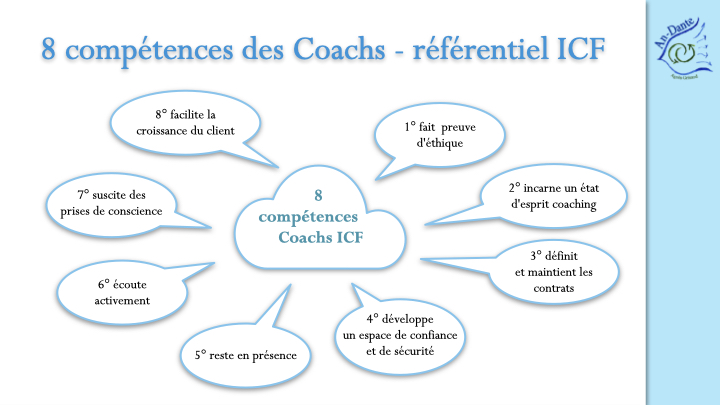
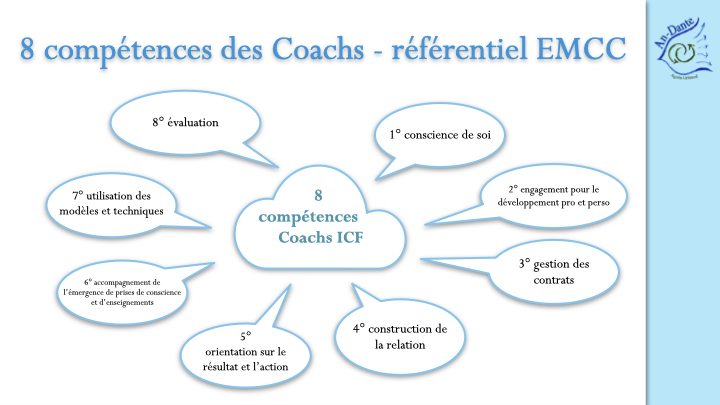
Ainsi, les référentiels des compétences des coachs professionnels permettent d’évaluer les compétences sur des critèresexplicites et partagés. Ce sont également des référentiels qui permettent au coach de mesurer sa progression dans sa professionnalisation et sa capacité à accompagner des situations de coaching de complexité croissante. Ces capacités du coach sont également en lien avec son propre développement, au sens du développement de l’adulte.
Les deux associations professionnelles des coachs ICF et EMCC ont écrit des référentiels, qui, s’ils présentent des différences, sont également très cohérents. Par ailleurs, le référentiel ICF a été réécrit en 2020, afin d’être en meilleure adéquation avec les résultats des recherches menées par l’association.
Professional coaches work from who they are. Thus, we say « I coach as I am »
This reality is absolutely fundamental. The tools of the coaches are also essential. However, it is mainly the way they are used that has an impact. And the variety available to the coach, allows to get out of the adage « for a hammer, everything is nail ».
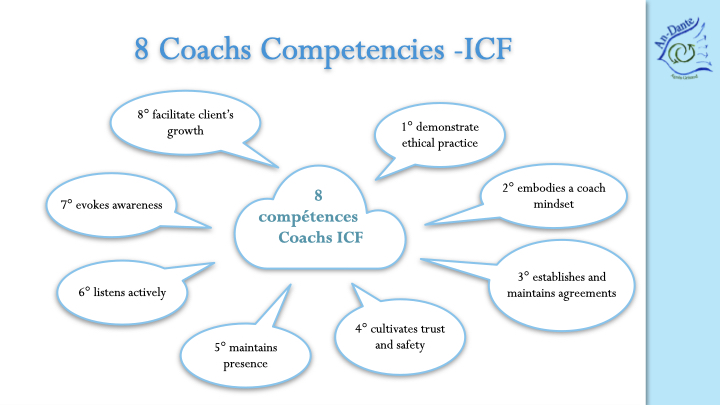
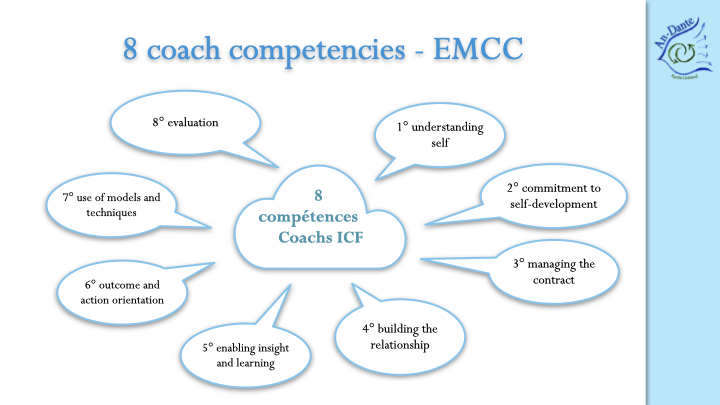
Thus, the competency frameworks of professional coaches make it possible to evaluate skills on explicit and sharedcriteria. They are also benchmarks that allow the coach to measure his progress in his professionalization and his ability to accompany coaching situations of increasing complexity. These abilities of the coach are also related to his own development, in the sense of adult development.
The two professional associations of coaches ICF and EMCC have written standards, which, if they present differences, are also very consistent. In addition, the ICF standard was rewritten in 2020, in order to be in better adequacy with the results of the research conducted by the association.
Are you a coach? How do you integrate these skills, to live them on a daily basis?
Are you a coaching client or buyer? How do these skills resonate in your choice?